
Kim Ju Ae absent from North Korea Workers Party congress
Seoul intelligence says successor stage, Dictatorship uses ambiguity to prevent elite focal points
Images
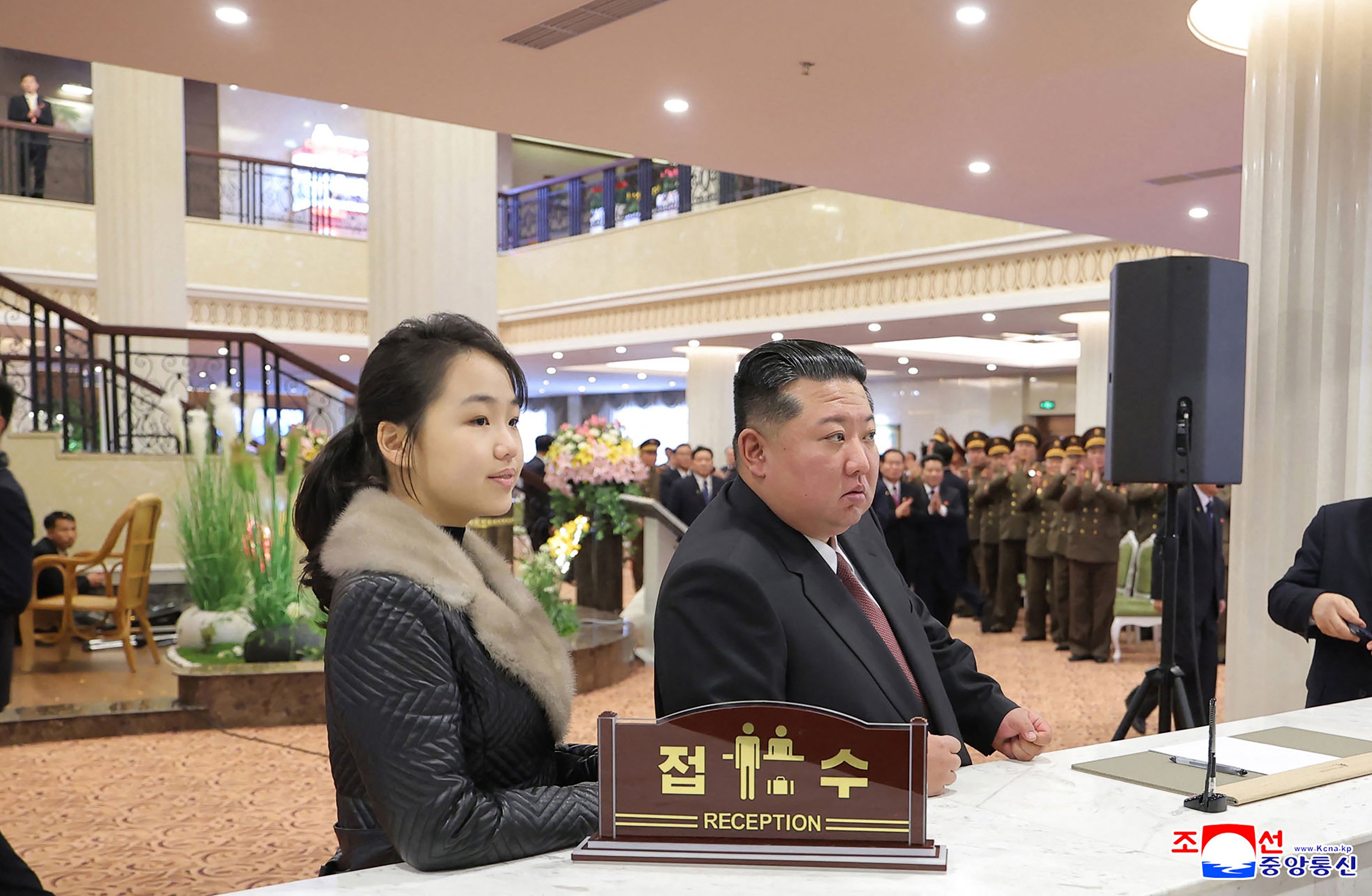 FILE: Kim Jong Un (right) and his daughter Ju Ae inspect the Milyong Hotel, which was recently completed in the Samjiyon tourist district of Ryanggang Province (KCNA)
KCNA
FILE: Kim Jong Un (right) and his daughter Ju Ae inspect the Milyong Hotel, which was recently completed in the Samjiyon tourist district of Ryanggang Province (KCNA)
KCNA
.jpeg) North Korean leader Kim Jong Un speaks during the Ninth Congress of the Workers' Party of Korea (WPK) in Pyongyang (via REUTERS)
via REUTERS
North Korean leader Kim Jong Un speaks during the Ninth Congress of the Workers' Party of Korea (WPK) in Pyongyang (via REUTERS)
via REUTERS
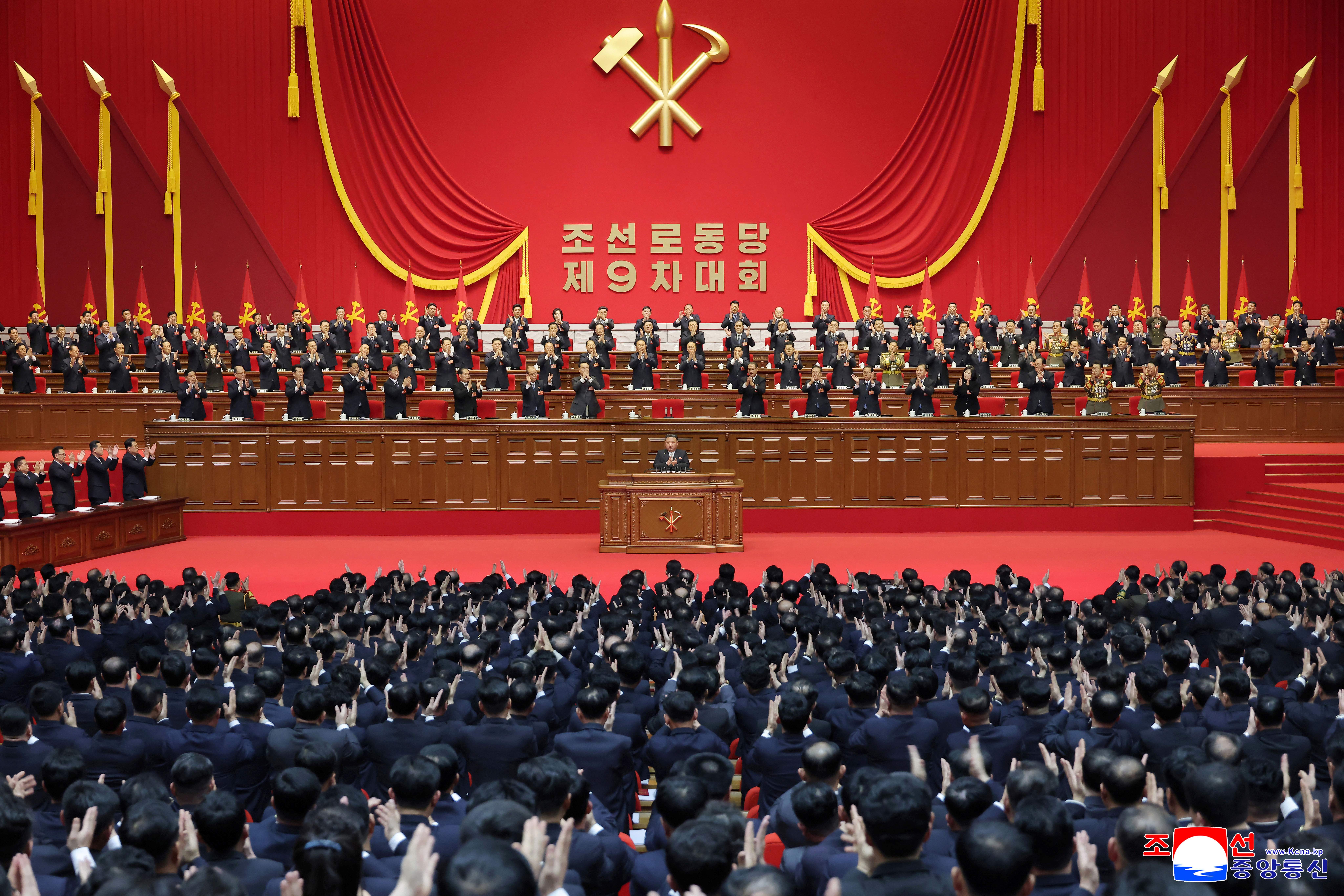 North Korean leader Kim Jong Un (C) delivers a report on the activities of the 8th Central Committee of the Workers' Party of Korea on the second day of the 9th Congress of WPK in Pyongyang (KCNA VIA KNS/AFP via Getty Image)
KCNA VIA KNS/AFP via Getty Image
North Korean leader Kim Jong Un (C) delivers a report on the activities of the 8th Central Committee of the Workers' Party of Korea on the second day of the 9th Congress of WPK in Pyongyang (KCNA VIA KNS/AFP via Getty Image)
KCNA VIA KNS/AFP via Getty Image
Kim Jong-un opened North Korea’s Ninth Congress of the Workers’ Party — the regime’s highest political gathering, held roughly every five years — without the one person foreign analysts have been trained to watch for: his daughter, Kim Ju Ae.
The Independent reports that Ju Ae, believed to be about 13, has appeared repeatedly at the most “high-signal” events a dictatorship can stage: missile tests, military parades, party celebrations and flagship construction projects since her first public debut in 2022. South Korea’s National Intelligence Service (NIS) recently briefed lawmakers that she had entered a “successor-designate stage,” raising expectations that the party congress might deliver an unmistakable cue.
Instead, she was absent.
In a normal polity, the non-attendance of a teenager would be non-news. In a dynastic system that treats imagery as policy, omission is information. The simplest reading is that Pyongyang is deliberately cooling succession speculation — not because the regime has abandoned the idea, but because premature focal points create bargaining problems inside the elite.
Succession in North Korea is not a constitutional process but a coordination game among security services, party cadres and the military-industrial complex. A designated heir reduces uncertainty in the long run, yet it also invites short-run factional positioning: courtiers compete to signal loyalty, rivals test boundaries, and the leader’s own bargaining power can weaken if elites begin discounting his future. By keeping Ju Ae visible enough to suggest a long time horizon — but absent from the one forum where “designation” would harden into perceived fact — Kim can harvest the stabilising effect of dynastic continuity without paying the immediate cost of an heir becoming a political asset others can trade.
There is also a gender constraint. The NIS initially doubted a female successor was plausible in a conservative, male-dominated ruling structure. Ju Ae’s frequent appearances have shifted that assessment, but the underlying problem remains: a female heir risks becoming a coordination failure if key institutions refuse to converge. Ambiguity, again, is a tool: it allows the regime to test elite acceptance gradually while retaining the option to pivot to another family member without admitting a reversal.
Kim’s congress speech, carried by state media and quoted by Reuters via The Independent, claimed the past five years were a “proud period” across politics, economy, defence and diplomacy, and hinted at a “great change” in the global political landscape — a likely reference to deepening ties with Russia and China. North Korea has reportedly sent thousands of troops to support Russia’s war in Ukraine, buying cash, technology and diplomatic cover.
That external alignment further explains the succession choreography. Wartime-adjacent mobilisation and sanctions evasion depend on tight control of the security apparatus. The regime may prefer to avoid any domestic storyline — such as a crowned successor — that could be interpreted as vulnerability or transition.
Ju Ae’s absence therefore does not falsify succession rumours; it underlines how the regime manages them: as a calibrated signal, not a promise. In Pyongyang, even family photos are a budget line in the state’s stability strategy.