
Juvenile clownfish shed white bars to survive anemone hierarchy
OIST study links stripe loss to social context, Status signalling evolves faster when eviction risk rises
Images
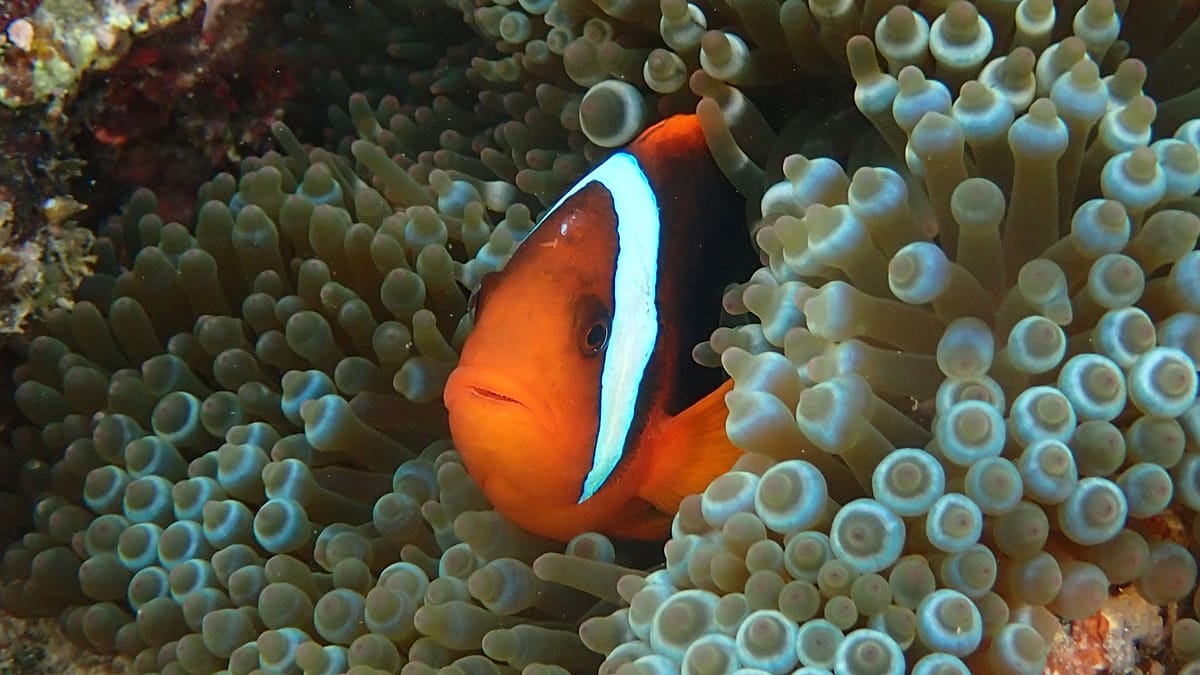 Teenagers often dress to look older – new study shows fish do it too
euronews.com
Teenagers often dress to look older – new study shows fish do it too
euronews.com
Juvenile clownfish are not just born into a hierarchy; they actively rewrite their own “uniform” to survive it.
A new study from the Okinawa Institute of Science and Technology (OIST), published in PLOS Biology and summarised by Euronews, finds that young tomato anemonefish (a clownfish species) accelerate the loss of their extra white bars when they live in an anemone already occupied by older fish. In clownfish societies, a single anemone typically hosts one breeding pair at the top and a queue of non-breeding subordinates below. Size and stripe patterns function as status signals. Smaller juveniles often carry one or two additional white bars—visual markers that, in effect, announce “I’m low rank, don’t waste energy fighting me.”
The surprise is that these subordinates shed the extra bars earlier when adults are present, even though the bars are used to signal submissiveness. According to the study’s first author, Dr Laurie Mitchell, earlier work showed anemonefish “count” bars to recognise individuals, so the markings are not decorative but communicative.
The best explanation is strategic signalling under uncertainty. After hatching, anemonefish spend a brief pelagic phase before settling into a host anemone. On arrival, a juvenile faces a bargaining problem: it must avoid provoking resident adults (who can evict or kill it), but also needs to secure a stable position before the next competitor arrives. Keeping “baby stripes” may reduce initial aggression—an honest signal of non-threat. But once accepted, lingering markers of low status may invite bullying, reduce access to shelter, or weaken the fish’s claim when new entrants appear. Losing bars early, then, can be read as a costly commitment to the local hierarchy: “I’m staying; treat me as part of the ladder.”
In unoccupied anemones, the incentives flip. Euronews reports that juveniles kept their extra bars longer, which the researchers interpret as an “insurance policy” against takeover by incoming adults. If eviction risk is high and social rules are not yet established, broadcasting submissiveness may be the cheapest way to avoid a fatal first encounter.
Mechanistically, the colour change is not a slow fade but a cellular demolition. The white bars are formed by iridophores—light-reflecting cells. Under the microscope, researchers saw mass cell death: cells shrink, membranes wrinkle, nuclei fragment, and the orange pigmentation replaces the white.
The broader point is that hierarchy is not only enforced by violence; it is stabilised by legible signals that reduce transaction costs. Humans outsource this to job titles, uniforms, LinkedIn headlines and org charts—often maintained by HR departments with budgets. Clownfish do it with stripes, paid for directly in biological capital. No subsidies, no ambiguity, and no appeals process—just a brutally efficient signalling market inside a sea anemone.