
Thailand coffee chains cut default sweetness under health drive
Sugar tax pushes reformulation while street vendors stay exempt, Soft regulation becomes industrial policy by compliance cost
Images
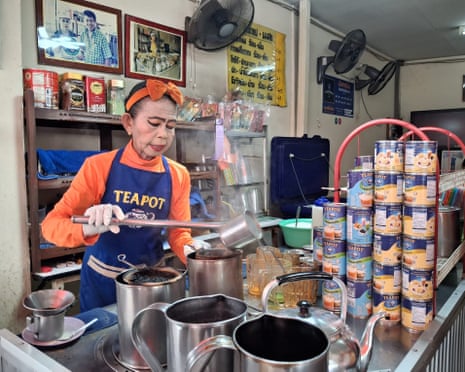 Auntie Nid, whose shop has served teas and coffees in Bangkok’s old town for 30 years, can’t comprehend changing her recipe to reduce sugar. Photograph: Rebecca Ratcliffe/The Guardian
theguardian.com
Auntie Nid, whose shop has served teas and coffees in Bangkok’s old town for 30 years, can’t comprehend changing her recipe to reduce sugar. Photograph: Rebecca Ratcliffe/The Guardian
theguardian.com
Thailand is trying to make the country’s national pastime — drinking sugar — slightly less automatic.
The government has secured commitments from nine major coffee chains to halve the sugar level that counts as “normal sweetness” in certain drinks, according to The Guardian. In practice, the old 100% setting becomes the new 50%. The campaign is framed as a public-health nudge aimed at retraining taste buds in a country where average consumption is estimated at 21 teaspoons of sugar per day, far above the World Health Organization’s suggested limit of six.
Thailand already has a sugar tax introduced in phases from 2017, with the last phase rolled out last year, targeting pre-packaged sweetened beverages. Mahidol University’s Pojjana Hunchangsith told The Guardian the tax’s biggest impact has been product reformulation: manufacturers cut sugar to avoid higher rates. That is the clean part of the policy story — a measurable incentive and a predictable response.
The messy part is where regulation stops. Street vendors and small cafés, which sell a dazzling range of made-to-order sweet drinks — Thai tea with condensed milk, boba, iced cocoa, “pink milk” — are largely outside the tax regime. Those sellers can keep their recipes intact while large chains absorb reformulation costs, menu redesign, staff training and customer backlash.
That asymmetry turns “health policy” into industrial policy by default. Large chains, with brand risk and legal exposure, comply; informal operators, with lower visibility and thinner margins, are left alone. The result is a state-created competitive advantage for the least regulated segment. If the aim is to reduce sugar intake, exempting a major source of sugar is an odd design choice — unless the real constraint is enforceability rather than outcomes.
Economically, the campaign functions like a shadow tax paid in non-price terms: consumers may face smaller portions of sweetness at the same sticker price, while chains spend on R&D and supply adjustments. Those costs are not itemised as a levy, but they still show up — in margins, in higher prices elsewhere on the menu, or in reduced product variety.
The Guardian cites research by Khon Kaen University economist Phumsith Mahasuweerachai suggesting that simply offering customers explicit sweetness options leads them to choose less sugar; calorie labels did little. This is the logic of default-setting: change what happens if the customer does nothing. It is also politically convenient. Defaults let governments claim progress without the backlash of overt bans.
Thailand’s experiment will be watched across Asia, where sugar taxes and “nudge” policies are proliferating. The question is whether the state is actually reducing harm — or merely shifting who pays for the paperwork and recipe changes, while the most lightly regulated sellers keep pouring three heaped tablespoons into a plastic bag of ice.