
Trump raises global tariff to 15% after Supreme Court blocks reciprocal levies
White House shifts from IEEPA to Section 122 and 232 and 301 authorities, Import taxes become executive workaround not congressional vote
Images
 U.S. President Donald Trump speaks during a press briefing at the White House in Washington on Friday, following the Supreme Court's ruling that he had exceeded his authority when he imposed tariffs.
japantimes.co.jp
U.S. President Donald Trump speaks during a press briefing at the White House in Washington on Friday, following the Supreme Court's ruling that he had exceeded his authority when he imposed tariffs.
japantimes.co.jp
 A solar farm in Nakai, Kanagawa Prefecture, in March 2016. Japan gets about a tenth of its electricity from solar panels despite having nearly no domestic production of photovoltaics (PVs).
japantimes.co.jp
A solar farm in Nakai, Kanagawa Prefecture, in March 2016. Japan gets about a tenth of its electricity from solar panels despite having nearly no domestic production of photovoltaics (PVs).
japantimes.co.jp
 Sonic the Hedgehog, Castlevania's Alucard and the weak yet lovable Slime from Dragon Quest are just some of Japan's iconic gaming franchises celebrating midlife anniversaries in 2026.
japantimes.co.jp
Sonic the Hedgehog, Castlevania's Alucard and the weak yet lovable Slime from Dragon Quest are just some of Japan's iconic gaming franchises celebrating midlife anniversaries in 2026.
japantimes.co.jp
 Yamagata co-hosts event on revitalizing rural economies
japantimes.co.jp
Yamagata co-hosts event on revitalizing rural economies
japantimes.co.jp
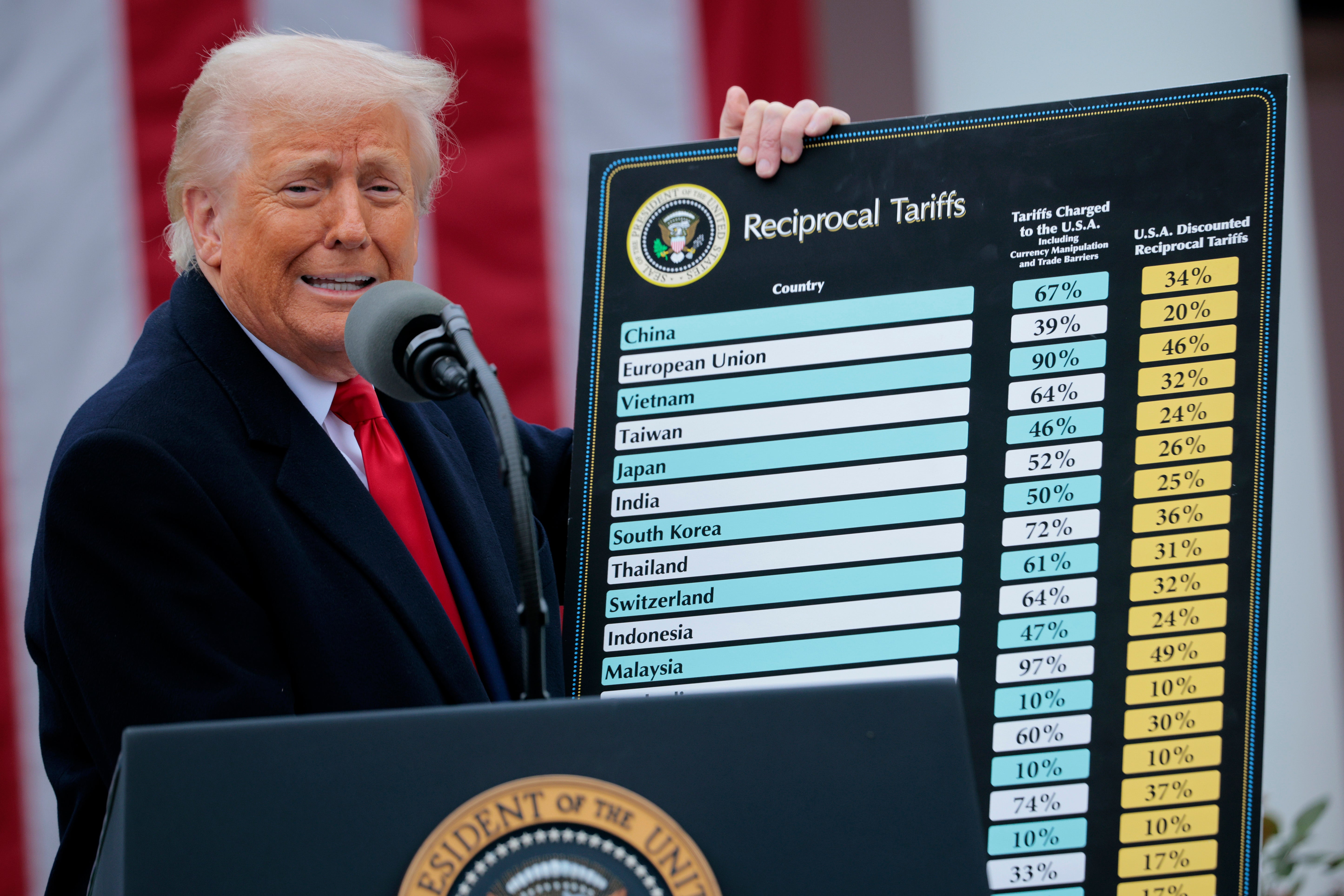 Donald Trump holds up a chart of ‘reciprocal tariffs’ during his trade announcement last April (Getty)
Getty
Donald Trump holds up a chart of ‘reciprocal tariffs’ during his trade announcement last April (Getty)
Getty
 Trump speaks to the press in the White House on Friday (AP)
independent.co.uk
Trump speaks to the press in the White House on Friday (AP)
independent.co.uk
 U.S. President Donald Trump, flanked by Secretary of Commerce Howard Lutnick (right) and Solicitor General D. John Sauer, holds a press briefing at the White House, following the Supreme Court's ruling that Trump had exceeded his authority when he imposed tariffs, in Washington on Friday.
japantimes.co.jp
U.S. President Donald Trump, flanked by Secretary of Commerce Howard Lutnick (right) and Solicitor General D. John Sauer, holds a press briefing at the White House, following the Supreme Court's ruling that Trump had exceeded his authority when he imposed tariffs, in Washington on Friday.
japantimes.co.jp
Donald Trump is trying to reassert unilateral tariff power within hours of a US Supreme Court ruling that struck down key parts of his “reciprocal tariffs” regime, escalating a constitutional tug-of-war over who gets to tax imports without Congress.
According to The Japan Times, which cites Reuters and Bloomberg, Trump announced on Saturday that he would raise a newly declared “worldwide” tariff from 10% to 15% “effective immediately,” after the court ruled he had exceeded his authority under the emergency-powers law he used to impose sweeping duties last April. The Independent reports that Trump attacked the justices as “fools,” claimed they were “swayed by foreign interests,” and promised to collect “even more money than we were taking in before.”
The legal pivot matters at least as much as the headline rate. Trump argues the court didn’t reject tariffs per se, but the particular statute and construction he used. He is now pointing to other legal hooks: Section 122 (a rarely used provision allowing temporary import surcharges in response to balance-of-payments problems), while insisting existing national-security tariffs under Section 232 and trade-remedy tariffs under Section 301 remain intact. If one path to executive taxation is blocked, the White House will shop for another.
That creates an institutional incentive problem. Congress has spent decades delegating trade authority to the executive—often to avoid taking direct responsibility for higher consumer prices—while courts periodically police the boundaries when presidents stretch delegations into general taxing power. The predictable response is not restraint but relabeling: “emergency,” “national security,” “temporary surcharge,” “unfair practices.” Each label is a bid to fit the same policy into a different statutory box.
Markets, meanwhile, price the meta-risk: not “tariffs yes/no” but “rule stability yes/no.” The Japan Times describes the ruling as dulling Trump’s preferred negotiating edge—tariffs as an instantly adjustable threat to extract concessions. But the attempt to replace the struck-down regime with a new global tariff underscores that the real leverage is domestic: the executive branch seeking speed and discretion, and everyone else—importers, exporters, trading partners—paying an uncertainty premium.
For Britain, the immediate question is whether carve-outs negotiated with Trump survive when the underlying tariff architecture changes. The Independent notes UK officials are betting their “privileged trading position” will continue, including sector-specific arrangements on steel, cars and pharmaceuticals. That confidence may prove optimistic: when tariffs become a White House instrument rather than a legislated schedule, exemptions are less a rule than a revocable favor.
Trade policy is also constitutional policy. If a president can impose a “global” tariff by executive order after losing in court—simply by switching statutes—then the dispute is not about protectionism. It is about whether the power to tax has quietly migrated from Capitol Hill to the Oval Office, one emergency declaration at a time.