
Australia becomes corpse flower hotspot
Botanic gardens propagate titan arum and brand blooms as events, conservation meets queue-managed disgust
Images
 Visitors look at the titan arum as it begins to bloom at the Adelaide Botanic Gardens in 2023. The state’s corpse flower collection now holds in excess of 250 plants across different generations – the largest in Australia, and possibly the world. Photograph: Matt Turner/EPA
theguardian.com
Visitors look at the titan arum as it begins to bloom at the Adelaide Botanic Gardens in 2023. The state’s corpse flower collection now holds in excess of 250 plants across different generations – the largest in Australia, and possibly the world. Photograph: Matt Turner/EPA
theguardian.com
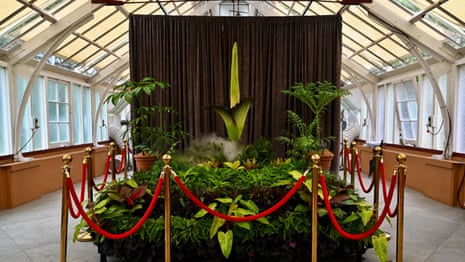 Putricia the corpse flower: would you wait 3.5 hours to smell a rotten carcass? - video
theguardian.com
Putricia the corpse flower: would you wait 3.5 hours to smell a rotten carcass? - video
theguardian.com
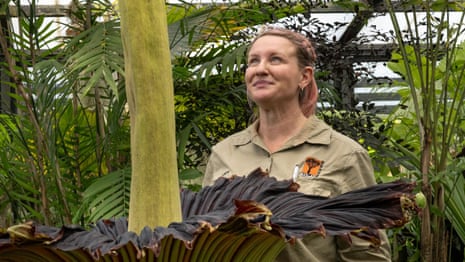 'A horrific smell': Geelong's corpse flower blooms – video
theguardian.com
'A horrific smell': Geelong's corpse flower blooms – video
theguardian.com
Australia is turning one of nature’s least marketable strategies—smelling like a rotting carcass—into a minor tourism boom.
According to The Guardian, “corpse flowers” (titan arum, Amorphophallus titanum) have been blooming with unusual frequency across Australia, with more than a dozen flowering events reported in 2025 alone. These blooms are famously rare and short-lived: the plant can take 10–12 years to produce its first flower, and even then there are no guarantees a bud will become a bloom rather than a leaf. When it does flower, the plant’s heat-producing inflorescence emits a stench designed to attract carrion insects—an evolutionary hack now repurposed as live entertainment.
The Guardian describes how botanic gardens have leaned into the spectacle by giving plants celebrity “personas” (Putricia, Stinkerella, Smellanie), turning a biological event into a shareable appointment. Sydney’s “Putricia” drew queues; elsewhere, gardens publicized blooms like product launches. The hook is partly scarcity economics: the flower may open for only a day or two, and the smell—variously compared to sweaty socks, blue cheese, fermenting cabbage—peaks quickly.
Adelaide has emerged as a propagation hub. The Botanic Gardens of South Australia, horticulture curator Matt Coulter told The Guardian, now holds more than 250 plants across multiple generations—possibly the largest collection in Australia, and perhaps globally. That scale matters because titan arum is endangered in its native Sumatran rainforest habitat, and cultivated collections are increasingly where reproduction and genetic continuity happen.
But the story is also about institutions learning to monetize controlled disgust. The titan arum’s bloom is unpredictable, requiring climate-controlled care and patient cultivation of enormous underground corms that can reach 75kg. Moving plants from glasshouse to public display is stressful and risky, The Guardian notes—yet gardens do it anyway because the payoff is foot traffic, media coverage, and a sense of civic participation in something “rare” that can be scheduled, ticketed, and branded.
The titan arum does not offer beauty, fragrance, or utility; it offers an experience. And like most experience economies, it works because scarcity is curated—by botanic gardens with budgets, staff, and infrastructure—rather than left to the rainforest.
The corpse flower’s popularity is a neat inversion of modern conservation politics: instead of banning, restricting, and guilt-tripping, gardens are selling people the privilege of standing in line to smell decay. Nature provides the stench; humans provide the queue management.