
Far-right marches in Manchester and Lyon met by mass policing
Macron threatens dissolutions of activist groups, State choreographs street conflict while claiming monopoly on legitimacy
Images
 Far-right anti-Islam march sparks counterprotests in Manchester
aljazeera.com
Far-right anti-Islam march sparks counterprotests in Manchester
aljazeera.com
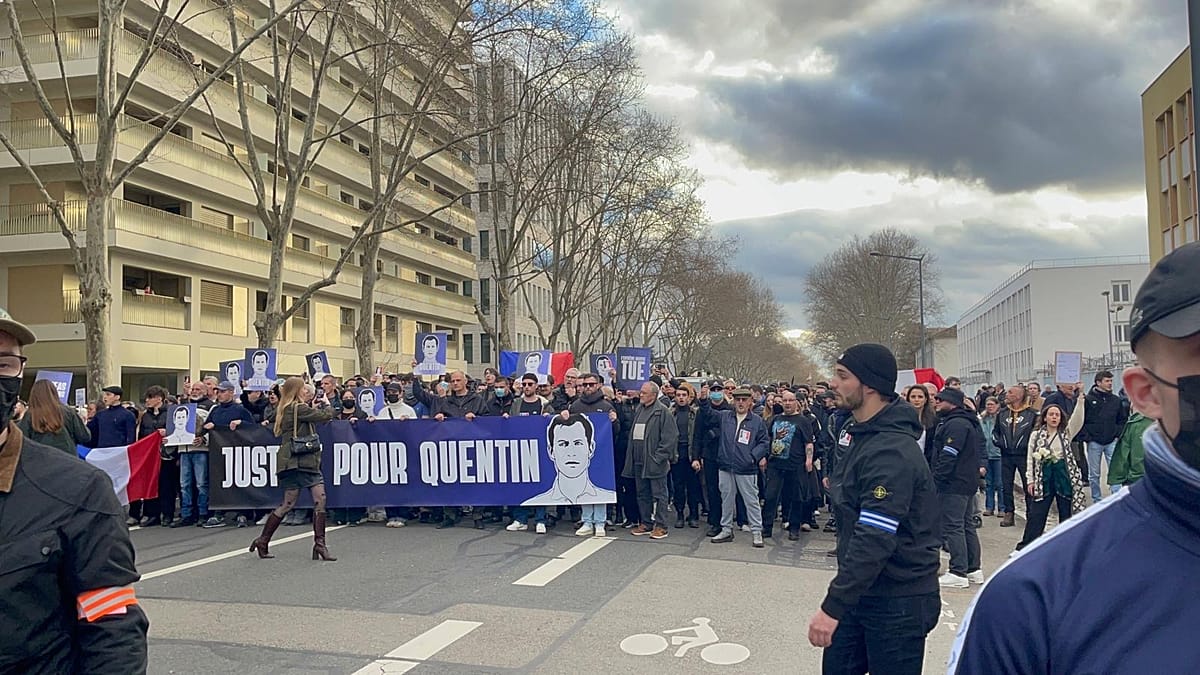 Over 3,000 people march in France in honour of far-right activist
euronews.com
Over 3,000 people march in France in honour of far-right activist
euronews.com
Far-right street politics in Manchester and Lyon is being treated as a public-order problem, but it is increasingly a governance model: the state choreographs rival crowds, declares itself the only legitimate actor, and then acts surprised when politics migrates from parliaments to pavements.
In Manchester on Saturday, an anti-Islam march drew counter-protesters, according to Al Jazeera. Police separated groups and managed the event under heavy presence—standard operating procedure for European democracies that have quietly turned dissent into a permit regime and public space into a managed venue. The stated goal is “preventing disorder”; the practical result is that politics is staged like a derby, with the state as referee and broadcaster.
France offered a cleaner case study in Lyon. Euronews reports that roughly 3,200 people marched in tribute to Quentin Deranque, a 23-year-old nationalist activist who died of brain injuries after a fight between far-right and far-left supporters near a student event where far-left lawmaker Rima Hassan spoke. Seven suspects face preliminary charges; prosecutors sought counts including intentional homicide, aggravated violence and criminal conspiracy.
President Emmanuel Macron responded by calling for calm—then promising a “comprehensive review” of violent activist groups with links to political parties, hinting at dissolutions. “In the republic, no violence is legitimate,” he said, adding there is “no place for militias, wherever they come from,” per Euronews.
The state tightens its grip on association and assembly to prevent “militias,” while simultaneously creating the incentives for politics to reappear as extra-institutional conflict. When legal expression is bureaucratized, the most motivated actors—whether the black-clad nationalists in Lyon or their self-identified anti-fascist counterparts—treat the street as the remaining arena where cost and commitment signal seriousness.
Euronews notes Lyon is viewed by intelligence services as a cradle of far-right activism, with newer far-left militant groups formed “in reaction” to long-standing far-right presence. Escalation as ecosystem, not anomaly. The state’s answer is to expand its catalog of banned groups and monitored networks—an approach that reliably shifts organization into looser, harder-to-police forms.
The same governments that insist violence has no legitimacy increasingly outsource legitimacy to police choreography: cordons, kettles, “buffer zones,” and selective enforcement that inevitably reads as political favoritism to whichever side is being held back today. When the state becomes stage manager, it also becomes a participant—just one with shields, surveillance, and prosecutors.
If Europe wants less street politics, it could start by lowering the stakes of politics—less centralized power, fewer speech-policing temptations, fewer symbolic crusades—and by treating public order as a narrow function rather than a pretext for managing ideology. But that would require politicians to give up the tool they reach for first: more discretion for the state, sold as neutrality.