
Paris custody death of El Hacen Diarra prompts new protest
Le Monde reports body-cam footage missing due to drained batteries while investigation stays inside state pipeline
Images
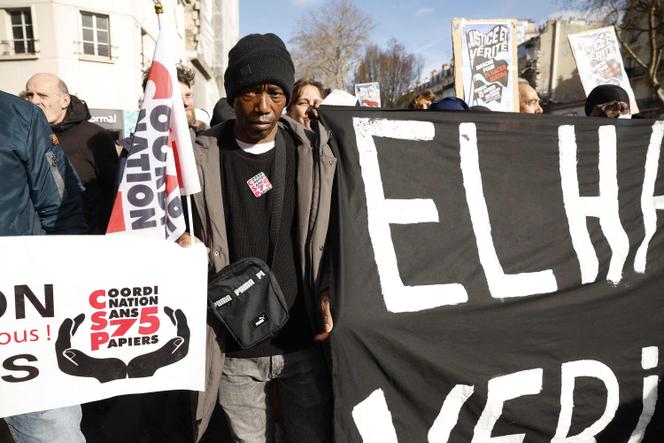 Lors d’une marche pour réclamer justice pour El Hacen Diarra, décédé en janvier dans un commissariat, à Paris, le 21 février 2026. CHARLOTTE SIEMON/AFP
CHARLOTTE SIEMON/AFP
Lors d’une marche pour réclamer justice pour El Hacen Diarra, décédé en janvier dans un commissariat, à Paris, le 21 février 2026. CHARLOTTE SIEMON/AFP
CHARLOTTE SIEMON/AFP
A month after 35-year-old El Hacen Diarra died in police custody in Paris, several hundred people marched on Saturday to demand “justice” and “truth.” The protest, reported by Le Monde citing AFP, targeted the police station in the 20th arrondissement where Diarra died during a garde à vue (custodial detention) on the night of January 15–16.
The mechanics matter because France’s custody system is designed to concentrate power and diffuse responsibility. Diarra was arrested near his workers’ hostel. His family alleges police violence. A neighbor’s video, described by Le Monde, shows two officers with the man on the ground; one officer, kneeling, appears to strike him twice.
Five days after the death, the Paris prosecutor’s office opened a judicial investigation for “intentional violence causing death” by a person vested with public authority—serious language that often functions as a holding pattern. The state’s favorite sentence, in France as elsewhere, is “an investigation is ongoing.” It signals activity without accountability.
The most revealing detail is not the charge; it is the missing evidence. Le Monde reports that the body-worn cameras of the officers involved produced no images because the cameras were allegedly not functioning due to drained batteries—an explanation the prosecutor said had been “verified” by an officer, without clarifying what “verified” means in a chain where police effectively certify police.
Diarra’s family lawyer, Yassine Bouzrou, filed an additional complaint for “destruction of evidence,” arguing that the battery explanation is “technically impossible and suspicious,” and raising the possibility that footage was destroyed or concealed. “Camera failure” has become a kind of bureaucratic miracle: the device exists to create oversight, but seems to lose power precisely when oversight would be inconvenient.
This is the structural problem with state monopoly policing: the institution that uses force also controls the documentation of that force, the internal reporting, and often the first layer of fact-finding. Even when prosecutors are formally independent, they depend on police for evidence collection and operational narratives. That dependency is not a conspiracy; it is the workflow.
The protest itself—200 to 300 people, per AFP—was smaller than an earlier march of “several thousand” on January 25, Le Monde notes. But the issue persists because the incentives persist. When accountability is optional and evidence is self-curated, “trust” becomes a marketing slogan rather than a governance principle.
France can promise reforms, new protocols, better cameras, better training. Yet the simplest accountability mechanism remains the one the state resists most: consequences that are swift, personal, and unavoidable—rather than procedural, institutional, and endlessly “under review.”