
US nears 1
000 measles cases in early 2026, outbreaks cluster in South Carolina and university campus in Florida, public-health logistics collide with politics and incentives
Images
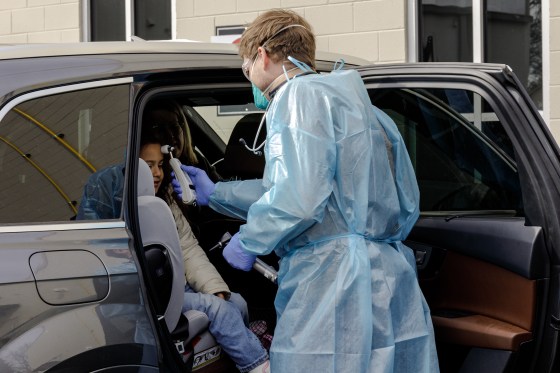 A young man holds a thermometer to a girl's forehead as she sits in the back seat of a car. He's wearing scrubs, a mask, and rubber gloves.
nbcnews.com
A young man holds a thermometer to a girl's forehead as she sits in the back seat of a car. He's wearing scrubs, a mask, and rubber gloves.
nbcnews.com
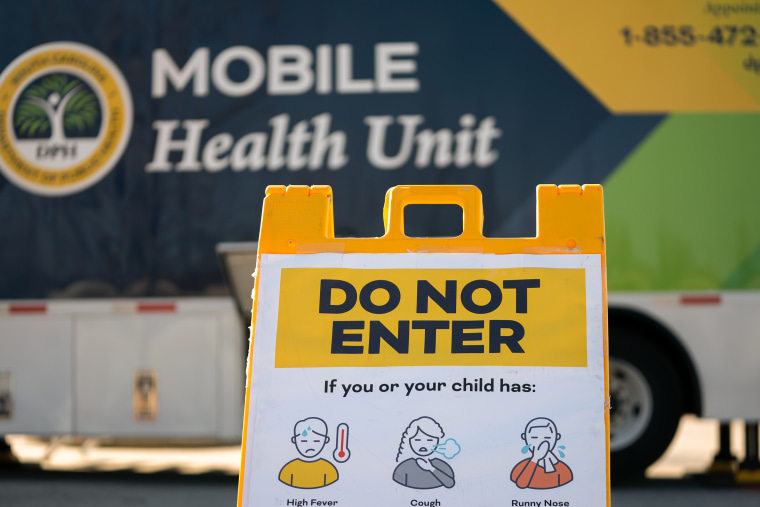 A mobile health clinic offering free measles vaccinations in Spartanburg, S.C. earlier this month. The state's is the largest single measles outbreak the U.S. has seen in a generation. Sean Rayford / Getty Images
nbcnews.com
A mobile health clinic offering free measles vaccinations in Spartanburg, S.C. earlier this month. The state's is the largest single measles outbreak the U.S. has seen in a generation. Sean Rayford / Getty Images
nbcnews.com
The United States has logged 982 measles cases in the first two months of 2026, according to NBC News citing the CDC—more than four times the count at the same point last year. Twenty-six states have reported cases, with large outbreaks in Utah, Arizona and especially South Carolina, where the running total has reached 973 since the outbreak began last fall. South Carolina alone has reported nearly 800 cases since January and at least 20 hospitalizations, state epidemiologist Linda Bell said.
Measles is often discussed as a morality play—anti-vaxxers versus public health—but it is, in operational terms, a logistics and incentives problem. The pathogen is brutally efficient (high transmissibility, airborne spread), but outbreaks remain highly clustered: they expand where immunity gaps exist and where institutions fail to enforce baseline rules around vaccination, isolation, and rapid contact tracing.
NBC notes that two doses of MMR vaccine are about 97% effective, leaving a small fraction of vaccinated people still susceptible. That matters because it becomes the rhetorical fig leaf for every bureaucratic overreaction and political blame game: the existence of “breakthrough” cases can be used both to undermine confidence (“see, it doesn’t work”) and to justify blanket restrictions (“no one is safe”). In reality, the overwhelming majority of cases are among the unvaccinated, and the public-health math still says the same thing it has said for decades: high coverage collapses transmission chains.
Florida illustrates the institutional dimension. The state has reported 92 cases this year, with 66 clustered at Ave Maria University near Naples. A graduate student told NBC affiliate WBBH he was vaccinated as a child, got sick anyway, and ended up in the ER for fluids—then isolated in his dorm for a week. Containment is not only about vaccine uptake; it also depends on how quickly organizations respond once a cluster appears. Universities, schools, and hospitals are effectively nodes in a contact network, and their incentives are mixed: they want to avoid bad headlines, avoid liability, and keep operations running.
The media and agency apparatus has its own incentives. A rising case count is a justification engine for budgets, emergency powers, and compliance campaigns, even when the practical work is local: verifying vaccination records, running targeted clinics, isolating cases, and communicating clearly without turning every rash into a national crisis.
NBC also highlights the long tail of measles harm: immune suppression after infection and rare but devastating subacute sclerosing panencephalitis (SSPE), sometimes years later. Doctors described a case of SSPE in a 7-year-old boy in the New England Journal of Medicine; he had contracted measles as an infant in Afghanistan, where the disease has not been eliminated.
That detail matters for a second, politically inconvenient reason: “elimination status” is not a magical shield in a world of constant travel and migration. If domestic vaccination rates fall and institutions treat immunization policies as optional suggestions, measles returns—not because the virus changed, but because governance got softer. The question for 2026 is whether US authorities will respond with targeted, competence-based containment—or with the usual mix of performative panic and sweeping rules that punish everyone except the bureaucrats who wrote them.