
Nobel laureate Omar Yaghi touts container-scale water-from-air machine
1,000 litres/day claim hinges on heat and sorbent mass, thermodynamics ignores PR
Images
 Prof Omar Yaghi, seen here testing a prototype in California’s Death Valley, grew up in a refugee community in Jordan. Photograph: Atoco
theguardian.com
Prof Omar Yaghi, seen here testing a prototype in California’s Death Valley, grew up in a refugee community in Jordan. Photograph: Atoco
theguardian.com
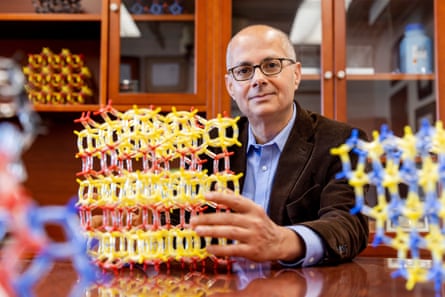 Omar Yaghi is a professor of chemistry at the University of California, Berkeley. Photograph: Brittany Hosea-Small/AP
theguardian.com
Omar Yaghi is a professor of chemistry at the University of California, Berkeley. Photograph: Brittany Hosea-Small/AP
theguardian.com
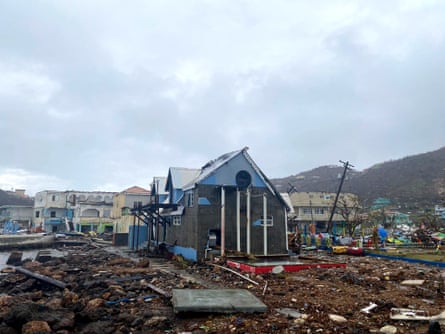 Damage caused by Hurricane Beryl in 2024 on Union Island in Saint Vincent and the Grenadines. Composite: Reuters
theguardian.com
Damage caused by Hurricane Beryl in 2024 on Union Island in Saint Vincent and the Grenadines. Composite: Reuters
theguardian.com
Chemist Omar Yaghi, the 2025 Nobel laureate in chemistry and a professor at UC Berkeley, is pitching a container-sized “atmospheric water harvesting” unit that allegedly produces up to 1,000 litres of clean water per day from dry air using only “ultra-low-grade thermal energy,” according to The Guardian. Yaghi’s company Atoco is marketing the system as an off-grid resilience tool for hurricane-prone Caribbean islands and drought-stricken communities—an appealing promise in a world where centralized water and power systems fail with impressive regularity.
The problem is that “water from air” is not magic; it is bookkeeping. To condense 1,000 litres/day you must (a) capture roughly a tonne of water vapour from a very large volume of air and (b) supply the energy to move that water from a low chemical potential (humid air) into a liquid phase you can store. The latent heat of condensation alone is about 2.26 MJ per kilogram of water—so roughly 2.26 GJ/day for 1,000 kg, before losses. If the device is not dumping that heat somewhere, it is not making that water. “Ambient thermal energy” is a real energy source, but it is diffuse, intermittent, and constrained by temperature gradients. A machine that runs on “low-grade heat” is a heat engine or heat pump problem, and thermodynamics is indifferent to press releases.
Atoco’s likely technical core is a sorbent cycle—adsorb water at night or during high relative humidity, then desorb during the day when warmed—using metal–organic frameworks (MOFs) or related engineered porous materials, an area where Yaghi is a pioneer. MOFs can indeed pull water at low humidity, and lab prototypes have shown gram-to-kilogram scale yields. Scaling to a tonne per day is not just “more MOF.” It means tonnes of sorbent, long-term stability under real-world dust and salt aerosols, fouling control, mechanical handling, and a thermal management system that can cycle that mass daily.
Then comes the ugly question: what is the true energy input? If the unit relies on solar-thermal collectors, forced-air fans, vacuum swings, or auxiliary electricity, the system is no longer “powered entirely” by ambient heat in the way a lay reader imagines. Even if it is mostly passive, the cost per litre will be dominated by capital cost, maintenance, and replacement of sorbent modules—especially if the materials degrade after thousands of adsorption/desorption cycles.
None of this makes the idea useless. In disaster logistics, water is heavy, transport is fragile, and a decentralized source that produces tens to hundreds of litres/day can be transformative for clinics, shelters, or remote outposts. But the leap from “possible” to “1,000 litres/day in a shipping container, off-grid, everywhere” is exactly where reproducibility matters.
The next step is not another quote about “changing the world,” but independent field validation: measured yield versus humidity and temperature, explicit energy flows, sorbent mass and lifetime, and a transparent cost-per-litre curve. Until then, the most valuable product may be political—another shiny object for governments that prefer grand procurement to the boring work of fixing pipes, pricing water, and letting people build resilient infrastructure themselves.