
Ecuador rose-export boom relies on pesticides and water extraction
Global buyers demand cosmetic perfection while local costs stay externalized
Images
 Roses are sprayed before being sent abroad from Cayambe in Ecuador, the world’s third-largest exporter of the flowers. Exposure to pesticides and other agrochemicals used in flower farming can cause serious skin complaints, while most workers show symptoms of pneumonitis. Photograph: Johis Alarcón
theguardian.com
Roses are sprayed before being sent abroad from Cayambe in Ecuador, the world’s third-largest exporter of the flowers. Exposure to pesticides and other agrochemicals used in flower farming can cause serious skin complaints, while most workers show symptoms of pneumonitis. Photograph: Johis Alarcón
theguardian.com
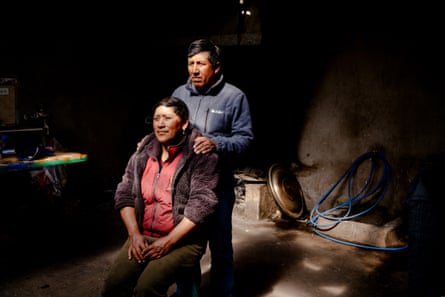 Patricia Catucuamba and Milton Navas are dairy farmers but started growing roses five years ago. They say they must diversify to survive. Photograph: Johis Alarcón
theguardian.com
Patricia Catucuamba and Milton Navas are dairy farmers but started growing roses five years ago. They say they must diversify to survive. Photograph: Johis Alarcón
theguardian.com
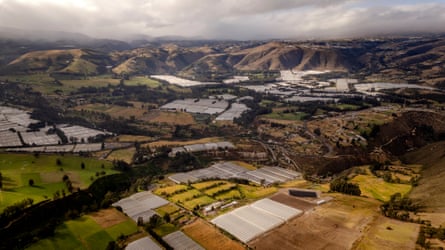 Fertile soil and intense sun help flower farms thrive in Cayambe. Photograph: Johis Alarcón
theguardian.com
Fertile soil and intense sun help flower farms thrive in Cayambe. Photograph: Johis Alarcón
theguardian.com
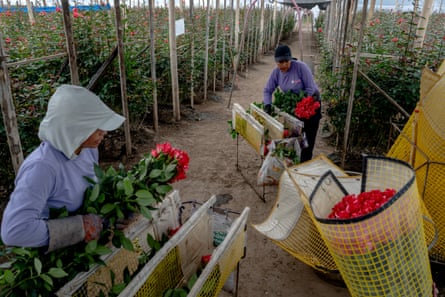 Some progress has been made in strengthening industry safety rules. Photograph: Johis Alarcón
theguardian.com
Some progress has been made in strengthening industry safety rules. Photograph: Johis Alarcón
theguardian.com
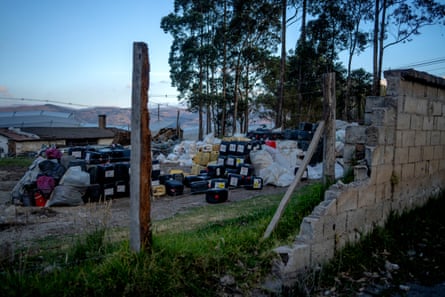 Agrochemical waste and plastics used by flower farms in Cayambe, which contaminate soil and water. Photograph: J Alarcón
theguardian.com
Agrochemical waste and plastics used by flower farms in Cayambe, which contaminate soil and water. Photograph: J Alarcón
theguardian.com
Ecuador’s rose industry sells perfection to foreign buyers—and invoices the costs to workers’ lungs and Andean water tables.
A report from The Guardian, datelined from La Chimba in Cayambe, describes how Ecuador’s export-flower machine has turned a high-altitude valley into an industrial greenhouse zone built around a single promise: flawless stems on schedule. Ecuador has become the world’s third-largest exporter of roses, shipping more than 2 billion stems annually, behind the Netherlands and Colombia, according to figures cited by the newspaper from Expoflores, the national association of flower producers and exporters. Roses account for roughly two-thirds of the country’s flower output.
The economics are straightforward: roses are a high-value export that can generate more revenue than traditional crops on less land. For small farmers, that’s the pitch. The Guardian profiles dairy farmers Patricia Catucuamba and Milton Navas, who added a 4,500-square-metre greenhouse at 3,300 meters altitude because “diversification isn’t just a strategy, it’s survival.” But the industry’s comparative advantage is not only volcanic soil and intense sunlight. It also includes low wages for Indigenous workers and weak enforcement of labor rights—advantages that read less like productivity and more like discounting human capital.
The externalities are where the “perfect rose” becomes a toxic product. The Guardian reports widespread pesticide and agrochemical exposure among flower workers, describing severe skin complaints and symptoms consistent with pneumonitis. The industry’s quality standards—large blooms, long stems, uniform appearance—translate into chemical intensity, because global buyers penalize blemishes while local producers compete on aesthetics.
Water is the other hidden input. The report notes that expanding rose cultivation is concentrated in the water-scarce Andes northeast of Quito. Greenhouses proliferate under white plastic, and the region’s integration into global markets is now so complete that exports flow not just to the U.S. and EU but also to Kazakhstan, described as a proxy and supply hub for Russia amid the Ukraine war. Global geopolitics can keep demand high even when local communities are running short.
Ecuador’s state appears in this story mostly as a licensing and oversight apparatus that fails to function as a rights guarantor. When labor enforcement is “limited” and water governance can’t price scarcity, the market signal that matters is the one sent by foreign procurement departments demanding cosmetic perfection.
This reading doesn’t require romanticizing regulators; it requires noticing that when property rights in health and water are weak, the “free market” becomes a subsidy pipeline from local communities to global consumers. The roses arrive pristine. The bill stays in Cayambe.