
Anna Murdoch-Mann dies at 81
Ex-wife who helped build Rupert Murdoch media empire then took $1.7bn exit, Succession-style dynasty outlives marriage
Images
 Anna Murdoch-Mann was married to Rupert Murdoch for 31 years and together they had three children. Photograph: Ken Faught/Toronto Star/Getty Images
theguardian.com
Anna Murdoch-Mann was married to Rupert Murdoch for 31 years and together they had three children. Photograph: Ken Faught/Toronto Star/Getty Images
theguardian.com
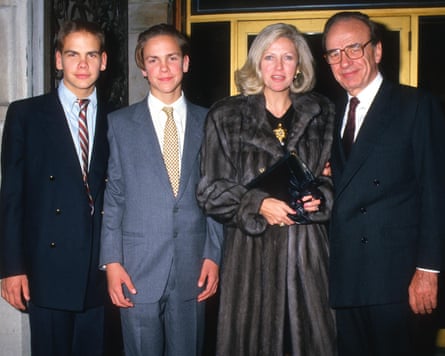 Anna Murdoch-Mann with Lachlan Murdoch, James Murdoch and Rupert Murdoch (L-R) in New York City in 1987. Photograph: Ron Galella/Ron Galella Collection/Getty Images
theguardian.com
Anna Murdoch-Mann with Lachlan Murdoch, James Murdoch and Rupert Murdoch (L-R) in New York City in 1987. Photograph: Ron Galella/Ron Galella Collection/Getty Images
theguardian.com
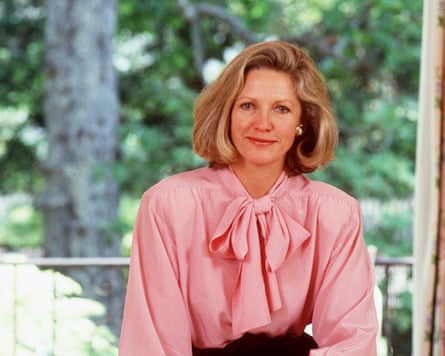 Anna Murdoch-Mann, former wife of Rupert Murdoch, photographed in 1988. Photograph: Paul Harris/Getty Images
theguardian.com
Anna Murdoch-Mann, former wife of Rupert Murdoch, photographed in 1988. Photograph: Paul Harris/Getty Images
theguardian.com
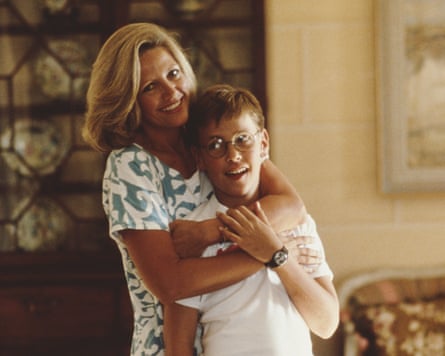 Anna Murdoch-Mann with her son, James, in 1985. Photograph: Michael Brennan/Getty Images
theguardian.com
Anna Murdoch-Mann with her son, James, in 1985. Photograph: Michael Brennan/Getty Images
theguardian.com
Anna Murdoch-Mann, the Scottish-born Australian journalist and novelist who spent three decades married to Rupert Murdoch before exiting the marriage—and, by her account, the News Corp boardroom—has died at 81 at her home in Palm Beach, Florida, according to The Guardian. The death was first reported by the New York Post, a Murdoch-owned tabloid, which is a neat encapsulation of the family’s core competence: controlling the channel even when the subject is a former spouse.
Murdoch-Mann (born Anna Torv in Glasgow) met Murdoch as an 18-year-old cadet reporter at the Sydney Daily Mirror, interviewing the young proprietor who had just bought the paper. The marriage lasted 31 years and produced three children—Elisabeth, James and Lachlan—who would later become protagonists in the real-world version of what television dramatized as Succession. The Guardian notes that biographers describe a difficult childhood after her parents split, followed by a rapid climb into Murdoch’s orbit and into journalism at the Mirror and later the Sydney Daily Telegraph.
Her public life after the divorce reads like personal relationships treated as corporate infrastructure. The couple split in 1998 after Murdoch’s affair with Wendi Deng. The divorce was finalized in 1999, with Murdoch-Mann reportedly receiving a $1.7 billion settlement. Weeks later, Murdoch married Deng on his yacht in New York Harbor—efficiency as romance, or romance as a press release.
Murdoch-Mann later said she was forced off the News Corp board in the wake of the split, and in a 2001 interview with Australian Women’s Weekly she described Murdoch as “extremely hard, ruthless, and determined” to proceed regardless of her efforts to save the marriage. That’s not just a marital complaint; it’s a description of a governance style. Shareholders might call it “decisive.” Spouses call it something else.
She wrote three novels—In Her Own Image (1985), Family Business (1988), and Coming to Terms (1992)—and pursued philanthropy focused on children, The Guardian reports. In 1999 she married Wall Street financier William Mann, who died in 2017; she later married Ashton dePeyster in 2019.
Her prescience about dynastic succession is the part that ages best. In that 2001 interview, she worried about her children competing to succeed their father. In September 2025, The Guardian says, a family deal left Lachlan Murdoch in control of the empire—Fox News, the Wall Street Journal, and the Times of London among the crown jewels—while three of his older siblings received an estimated $1.1 billion each for their shares.
The “fight” was resolved the way most high-stakes family disputes are resolved—by converting emotion into a balance-sheet entry. Dynasties survive; marriages don’t. The market, for once, is not the villain here. The villain is the idea that a media empire can be run like a family and a family can be managed like a corporation—without anyone getting hurt in the process.