
Palestinian-American teen killed in West Bank settler attack
Israel denies troops fired as arrests unclear, dual legal systems turn accountability into permission
Images
 Family members with the body of Nasrallah Abu Siyam, who was shot dead on Wednesday. Photograph: Nasser Nasser/AP
theguardian.com
Family members with the body of Nasrallah Abu Siyam, who was shot dead on Wednesday. Photograph: Nasser Nasser/AP
theguardian.com
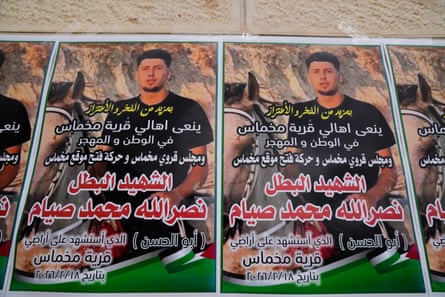 Posters with the name and picture of Nasrallah Abu Siyam. Photograph: Nasser Nasser/AP
theguardian.com
Posters with the name and picture of Nasrallah Abu Siyam. Photograph: Nasser Nasser/AP
theguardian.com
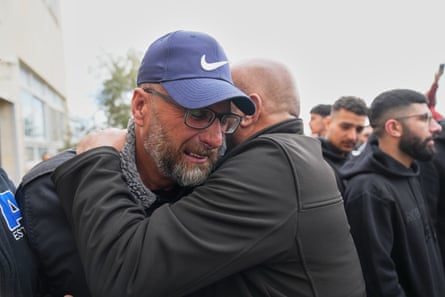 Mohammad Abu Siyam, the father of the victim. Photograph: Nasser Nasser/AP
theguardian.com
Mohammad Abu Siyam, the father of the victim. Photograph: Nasser Nasser/AP
theguardian.com
A 19-year-old Palestinian-American, Nasrallah Abu Siyam, was shot dead during a settler attack on the occupied West Bank village of Mukhmas, according to the Associated Press via The Guardian. The killing is now being treated—by everyone who matters—as a test of “rule of law” under occupation, which is another way of asking who, exactly, has jurisdiction when two legal systems share the same geography.
Witnesses told AP that settlers attacked a farmer, residents intervened, and Israeli forces then arrived. Raed Abu Ali, a local resident, said the army used tear gas, sound grenades and live ammunition, while armed settlers shot Abu Siyam and beat injured Palestinians with sticks after they fell. Israel’s military acknowledged using “riot dispersal methods” after reports of stone-throwing but denied its forces fired during the clashes, The Guardian reports.
The Israeli military said “suspects” shot at Palestinians who were evacuated for treatment, but it did not say whether anyone was arrested. That omission is the point. Under occupation, accountability is not a principle; it is a permissions system.
The New York Times, reporting from the funeral, identifies Abu Siyam as the latest Palestinian-American killed in the West Bank amid rising settler violence and Israeli raids. The US embassy condemned the violence, per The Guardian—an elegant diplomatic gesture from the same state that bankrolls the security architecture in which these events occur.
The UN humanitarian office recorded 240 Palestinians killed by Israeli forces and settlers last year, versus 17 Israelis killed by Palestinians, The Guardian notes. The Palestinian Authority’s Wall and Settlement Resistance Commission said Abu Siyam is the first Palestinian killed by settlers in 2026.
Mukhmas sits in an area where “most” land lies under Israeli civil and military administration, The Guardian reports, and has become a hotspot for outposts, arson and assaults. Outposts are often illegal even under Israeli law, yet their existence is functionally protected by the state’s monopoly on force. This is how private violence and state violence merge: not through conspiracy, but through incentives. Settlers expand facts on the ground; the state supplies roads, permits, policing and—when challenged—crowd-control.
On Thursday, the UN human rights office accused Israel of war crimes and said practices that displace Palestinians and alter the West Bank’s demographic composition raise concerns about ethnic cleansing. It described an “accelerating effort to consolidate annexation” while maintaining a system of domination over Palestinians, according to The Guardian.
So who investigates Abu Siyam’s death? Who prosecutes? Who judges? In theory, multiple entities. In practice, nobody with the power to impose costs on the armed men who showed up, shot an American citizen, and walked away into a jurisdictional fog bank.
That is what “rule of law” looks like when the sovereign is also the referee.