
China parades humanoid robot fighters on Spring Festival Gala
State TV spectacle doubles as industrial-policy subsidy funnel, choreography replaces transparency on costs and capability
Images
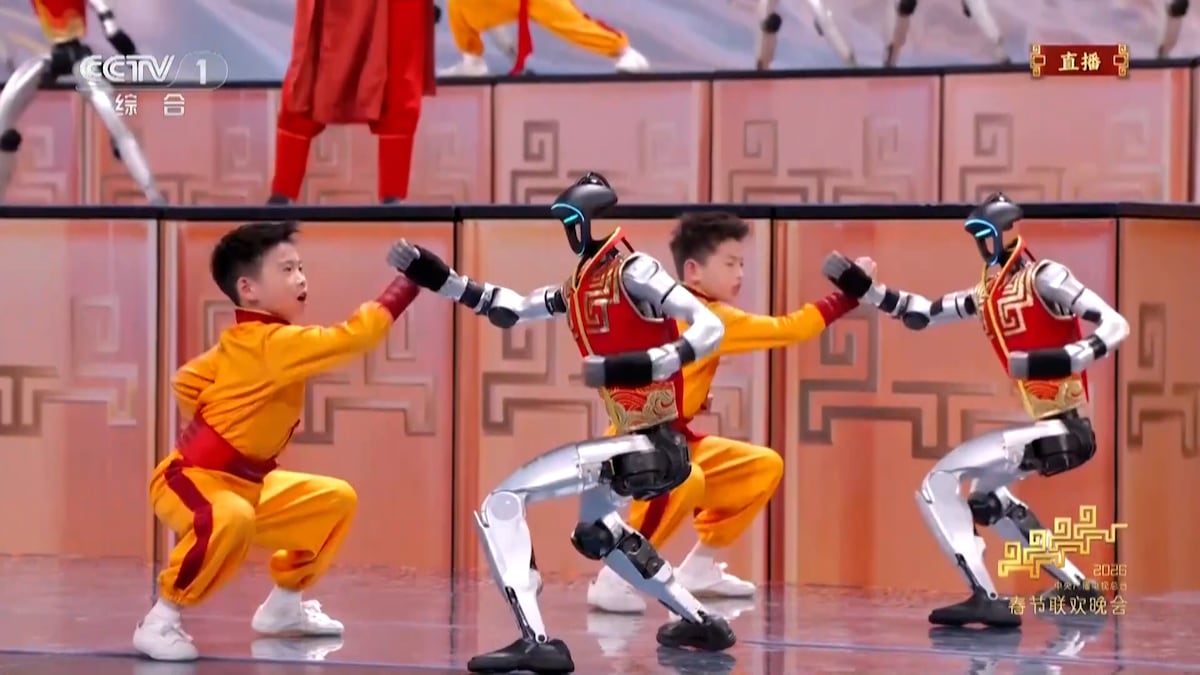 China’s robot warriors: A show of technological prowess that goes far beyond the Lunar New Year spectacle
english.elpais.com
China’s robot warriors: A show of technological prowess that goes far beyond the Lunar New Year spectacle
english.elpais.com
China used its Lunar New Year Spring Festival Gala — routinely described as the most-watched television program on Earth — to stage a not-at-all-subtle advertisement for industrial policy. El País reports that the broadcast, watched by roughly 600 million people, featured hyper-realistic humanoid robots in comedy skits and, more memorably, a choreographed martial-arts sequence in which a squad of humanoid “robot warriors” executed kicks, flips, synchronized weapon work, and a finale featuring a larger saber-wielding unit.
The point was not entertainment. It was state signaling: a televised proof-of-life for Beijing’s robotics push at a moment when Washington is tightening export controls and China is advertising “self-sufficiency” as if it were a consumer feature. Georg Stieler, a robotics and automation consultant, told El País that the Gala’s tech showcases align with government strategies from Made in China 2025 to the 14th Five-Year Plan, and that companies showcased on the program are rewarded with government contracts, investor attention, and market access. The show is also a procurement pipeline.
The numbers cited underline why the propaganda writes itself. China accounted for nearly 90% of the roughly 13,000 humanoid robots sold worldwide last year, according to Omdia figures referenced by Reuters and cited by El País. Morgan Stanley forecasts China’s humanoid robot sales will double to 28,000 units this year. If accurate, that is not a “cool demo” story; it is the early phase of a domestic market being manufactured through coordinated capital, regulation, and state purchasing.
Beijing’s stated rationale is demographic arithmetic. The UN projects China’s working-age population will shrink by more than 20% — about 200 million people — by 2050, El País notes. Faced with that, the government is betting that robotics-driven productivity gains can offset an aging society. The next Five-Year Plan, expected to be approved in March, reportedly warns that China must be prepared for “violent storms” — a phrase that conveniently covers everything from sanctions to economic slowdown.
Yet the Gala’s robot kung fu also highlights the regime’s favorite substitution: choreography for transparency. A staged performance can demonstrate balance, actuation, and control loops under ideal conditions; it cannot reveal unit economics, maintenance burdens, sensor supply-chain dependencies, or whether the software stack is robust outside a television studio. Nor does it show what matters in real deployment: uptime, safety certification, liability, and the boring but decisive details of integration into factories, warehouses, and military logistics.
A centralized system that distrusts open markets still needs markets — it just prefers them administered. The Gala’s “robot warriors” are less a glimpse of the future than a reminder that when the state picks winners, it also picks the narrative. Investors and contractors will applaud; taxpayers will eventually receive the bill — likely labeled, with patriotic solemnity, as “resilience.”