
NATO deploys Turkish drone carrier TCG Anadolu to Baltic
Eastern Sentry answers Russian airspace violations, Cheap ISR scales faster than brigades
Images
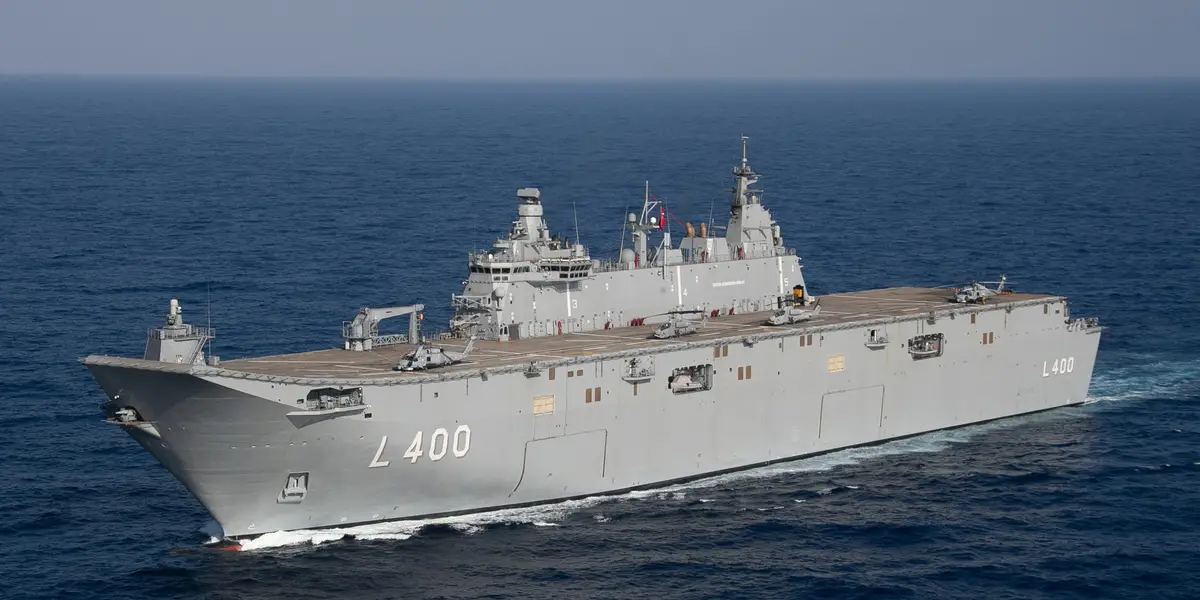 NATO is deploying a drone carrier to its eastern edge after repeated Russian airspace incursions
dnyuz.com
NATO is deploying a drone carrier to its eastern edge after repeated Russian airspace incursions
dnyuz.com
NATO is sending Turkey’s TCG Anadolu—an amphibious assault ship repurposed as a drone carrier—toward Latvia as part of its “Eastern Sentry” posture after what Allied Joint Force Command Brunssum described as “repeated” Russian airspace violations, according to Business Insider.
The move is framed as an air-defense surge, but the platform choice is revealing. Anadolu is not an American supercarrier or even a classic European fixed-wing carrier. It is a 750-foot Turkish flagship, commissioned in 2023, whose original concept was built around operating F‑35B jets. That plan ended when Ankara was removed from the F‑35 program after purchasing Russian S‑400 air-defense systems—an episode that neatly captures NATO’s internal contradictions: one member buys strategic kit from the alliance’s primary adversary, then becomes the alliance’s preferred tool for signaling resolve.
Turkey and manufacturer Baykar turned the problem into an opportunity. Anadolu can operate Bayraktar TB‑3 and Kızılelma unmanned combat aircraft, plus helicopters, giving NATO a sea-based, persistent intelligence-surveillance-reconnaissance (ISR) and limited strike option without the logistics tail and political overhead of deploying large ground formations. JFC Brunssum called Anadolu the largest ship in NATO’s Steadfast Dart fleet (17 vessels). NATO did not specify the exact arrival date or duration of the deployment, Business Insider notes.
Eastern Sentry began in September after Russian drones reportedly crossed into Polish airspace, forcing a military response. Since then, allies have surged fighters and warships in the Baltic region. The Anadolu deployment fits a pattern: when Europe wants “more defense” quickly, it increasingly buys time with sensors, drones, and maritime presence—systems that can be rotated, photographed, and press-released.
There is a strategic logic here. Drones offer endurance and numbers; they can watch air corridors, cue interceptors, and complicate any adversary’s planning at relatively low marginal cost. They also avoid the messy domestic politics of mobilization, procurement timelines measured in decades, and the hard question of whether Europe can field and sustain heavy brigades at scale.
But the same logic can be read less charitably: NATO’s most scalable response is the one that looks like capability while postponing the expensive part—mass, munitions stockpiles, and trained manpower. In that sense, Anadolu is a floating admission that bureaucracies can spin up ISR faster than they can rebuild deterrence.
Iran and China have also developed drone-carrier concepts, and Portugal expects to receive one later this year, Business Insider adds. The future of “presence” may be less about capital ships and more about who can keep cheap aircraft in the air the longest—while everyone else argues about budgets and basing rights.