
Venezuela passes amnesty bill for political detainees
Exclusions and procedural hooks keep freedom as state-issued credit
Images
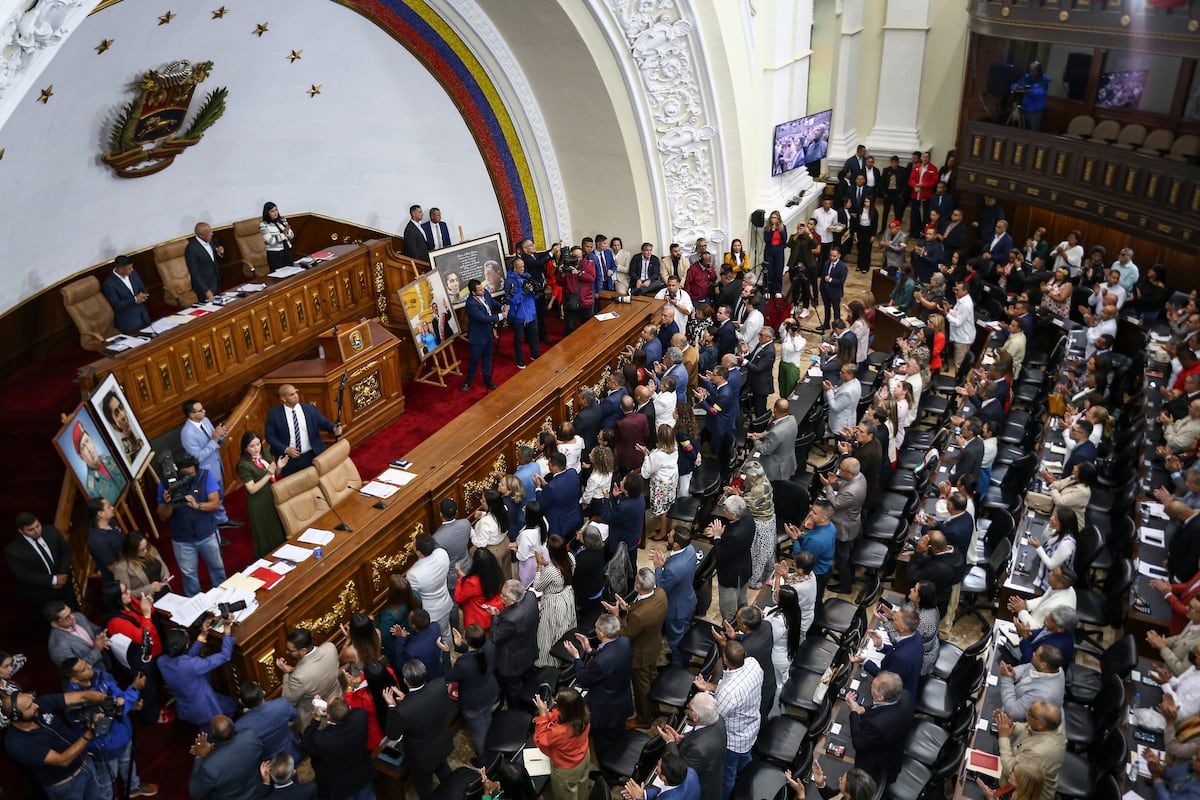 Venezuela’s National Assembly gives unanimous approval to amnesty bill
english.elpais.com
Venezuela’s National Assembly gives unanimous approval to amnesty bill
english.elpais.com
 Venezuela grants amnesty that could release hundreds of political detainees
aljazeera.com
Venezuela grants amnesty that could release hundreds of political detainees
aljazeera.com
Venezuela’s National Assembly has passed an amnesty bill that could free hundreds of political detainees and drop prosecutions of opposition figures in hiding or exile. In a normal legal system, “amnesty” is a political reset. In an authoritarian one, it is a credit facility—freedom issued as a revocable IOU.
El País reports the law was approved unanimously after two weeks of consultations with political and civil society groups and was immediately sent to Miraflores Palace for interim president Delcy Rodríguez to sign. The bill’s stated scope covers 13 defined periods of political conflict between 1999 and 2026, including the opposition-controlled National Assembly era (2016–2021), the 2023 opposition primary process, and the July 2024 election unrest when the state deployed harsh repression.
But the generosity is carefully engineered. The law explicitly excludes military personnel accused of rebellion—174 of roughly 600 political prisoners still incarcerated, according to El País. That carve-out is not a footnote: it preserves the regime’s leverage over the one constituency with the capacity to change facts on the ground.
The bill also avoids confronting the regime’s favorite elastic category: “hate crimes.” El País notes those convicted under such provisions—sometimes for something as trivial as a critical WhatsApp message—are not expressly covered. The Assembly’s president, Jorge Rodríguez, called the law “very useful” and admitted it had not always been applied “appropriately,” promising reform later. The tool remains on the wall.
A 23-member parliamentary commission will monitor implementation, with opposition lawmakers tasked with seeking reviews for excluded cases. That is an institutional way of saying the state keeps the keys. The debate reportedly stalled over Article 7, which, according to El País, reflected Chavismo’s insistence that beneficiaries must submit to the justice system—the same justice system that jailed them. NGOs and families objected: for them, the point is not pardon for crimes but recognition that the “crimes” were political inventions.
Al Jazeera similarly describes an amnesty that “could release hundreds,” underscoring the scale while leaving room for the usual discretion that turns law into management.
Families of detainees have been staging vigils outside prisons. El País reports 444 people have been released in the last month and a half, yet at least 600 remain. The amnesty arrives, then, not as a concession of principle but as a calibrated release valve.
For the regime, the logic is simple: amnesty reduces pressure without surrendering control. It can be granted selectively, conditioned procedurally, and quietly undermined by prosecutors, courts, and security services. Freedom becomes something you receive from the state—and therefore something the state can price, ration, and threaten to withdraw.
The bill may still liberate real people from real cells. But it also reinforces the central fiction of authoritarian legality: that the state is merciful for refraining from punishing what it criminalized in the first place.