
Antarctic Peninsula study maps best- and worst-case warming scenarios
Frontiers in Environmental Science models ocean heat, sea ice, ice-shelf risks, Uncertainty bands become policy props
Images
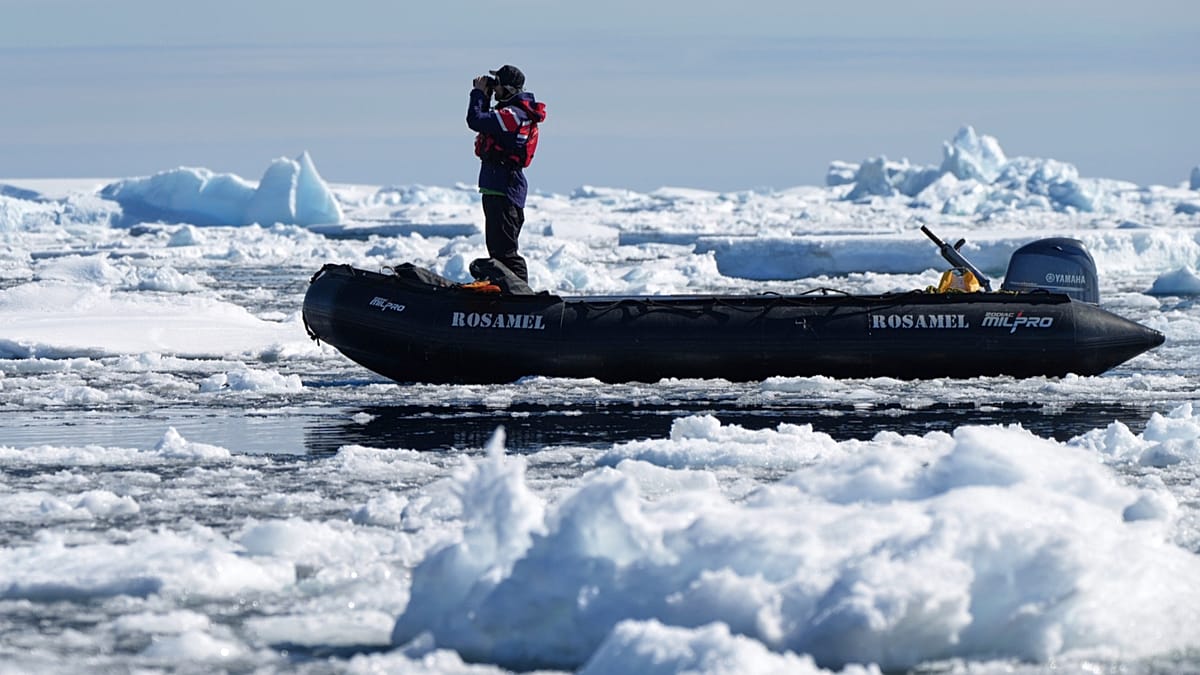 ‘Frightening prospect’: What will happen if Antarctica keeps warming?
euronews.com
‘Frightening prospect’: What will happen if Antarctica keeps warming?
euronews.com
 Antarctica's worst-case climate scenario laid bare
dailymail.co.uk
Antarctica's worst-case climate scenario laid bare
dailymail.co.uk
A new study on the Antarctic Peninsula offers a familiar menu: best-case, worst-case, and a moral about “choices we make today.” Euronews summarizes the paper, published in Frontiers in Environmental Science, as modelling outcomes under three warming pathways—about 1.8°C, 3.6°C, and 4.4°C above preindustrial levels by 2100—and assessing eight domains from sea ice and ice shelves to ecosystems and extreme events.
The useful part is not the apocalyptic prose (“irreversible on any human timescale”), but the implied model structure: scenario-driven projections that connect atmospheric warming to Southern Ocean heat uptake, then to ice–ocean interaction, then to ecological knock‑ons. The dangerous part is how quickly those links are presented as a single storyline rather than a chain of assumptions.
On the Peninsula, ocean heat matters because warmer water can increase basal melt of ice shelves—the floating buttresses that slow the seaward flow of land ice. Lose the shelves and you can accelerate glacier discharge. That’s a physical mechanism, not a political slogan. But the magnitude and timing depend on parameterizations that remain stubbornly uncertain: how much warm water reaches the shelf cavities, how mixing behaves under changing winds, and how fracture processes respond when surface meltwater exploits crevasses.
Euronews highlights one headline number: under the highest-emissions scenario, sea-ice coverage could fall by 20% by 2100. That sounds crisp until you ask: 20% relative to which baseline and which season? Antarctic sea ice is notoriously variable, and Peninsula trends can diverge from the continent-wide picture.
The article also claims that a low-emissions pathway could limit sea-level rise to “a few millimetres.” That phrasing risks conflating local Peninsula changes with global sea level, which is dominated by the big ice sheets and thermal expansion. Even within Antarctica, sea-level contribution depends on whether dynamic instabilities are triggered in vulnerable basins—topics that are not settled by a Peninsula-focused synthesis.
Then there’s the politics. The Daily Mail repackages the same material with maximal dread, because nothing says “science journalism” like mixing climate modelling with unrelated royal gossip in the sidebar. Yet both outlets converge on the same rhetorical move: translate wide uncertainty bands into a single emotionally legible narrative.
A reading is not “ignore the models,” but “don’t outsource judgement to them.” Models are tools; they are not mandates. When journalists and officials treat scenario outputs as marching orders, the result is usually more centralized authority, more subsidy schemes, and more emergency rhetoric—while coastal communities are left with the unglamorous work of adaptation, property rights, and resilient infrastructure.
Antarctica will keep doing what physics allows. Politicians may use that uncertainty as an excuse to do what politics prefers.