
Israel tightens control at al-Aqsa/Temple Mount as Ramadan begins
1967-era prayer status quo breaks under arrests raids and access bans, sacred-space ambiguity turns into a sovereignty test
Images
 Palestinian Muslim worshippers banned from entering al-Aqsa mosque compound pray outside at the end of the first day of Ramadan. Photograph: John Wessels/AFP/Getty Images
theguardian.com
Palestinian Muslim worshippers banned from entering al-Aqsa mosque compound pray outside at the end of the first day of Ramadan. Photograph: John Wessels/AFP/Getty Images
theguardian.com
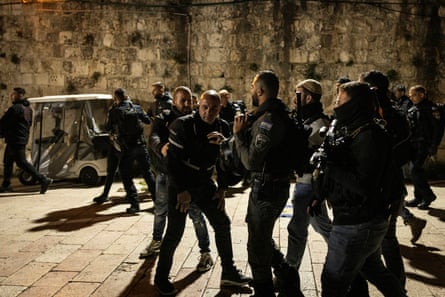 Israeli security forces stop Muslim worshippers from praying outside after they were banned from entering al-Aqsa mosque compound on Wednesday. Photograph: John Wessels/AFP/Getty Images
theguardian.com
Israeli security forces stop Muslim worshippers from praying outside after they were banned from entering al-Aqsa mosque compound on Wednesday. Photograph: John Wessels/AFP/Getty Images
theguardian.com
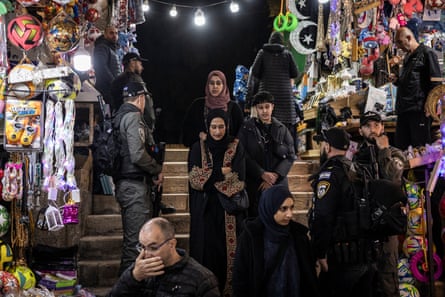 Muslim worshippers walk past Israeli security forces as they leave al-Aqsa mosque compound on Wednesday evening. Photograph: John Wessels/AFP/Getty Images
theguardian.com
Muslim worshippers walk past Israeli security forces as they leave al-Aqsa mosque compound on Wednesday evening. Photograph: John Wessels/AFP/Getty Images
theguardian.com
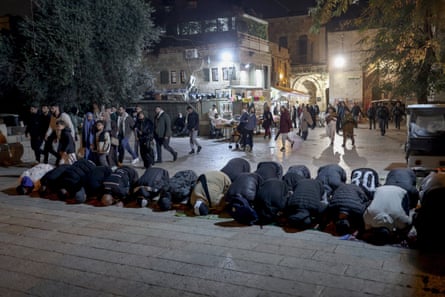 Palestinian worshippers offer prayers on Wednesday evening next to the entrance of al-Aqsa mosque after they were prevented from entering. Photograph: Atef Safadi/EPA
theguardian.com
Palestinian worshippers offer prayers on Wednesday evening next to the entrance of al-Aqsa mosque after they were prevented from entering. Photograph: Atef Safadi/EPA
theguardian.com
Israel’s long-running “status quo” at Jerusalem’s most combustible hilltop holy site is fraying into something closer to explicit state enforcement.
According to The Guardian, a six-decade informal arrangement governing the al-Aqsa/Temple Mount compound has “collapsed” as Ramadan begins. The post-1967 understanding—administered day-to-day by the Islamic Waqf under Jordanian custodianship—held that Muslims may pray within the compound (al-Haram al-Sharif), while non-Muslims may visit but not conduct prayer. The whole point of the arrangement was to keep competing claims to sovereignty and sacred space from becoming a daily referendum on who rules Jerusalem.
The Guardian reports that Israeli police and the Shin Bet have in recent days arrested Muslim caretaker staff, barred “hundreds” of Muslims from entering, detained the imam of al-Aqsa, and conducted a police raid during evening prayers on the first night of Ramadan. In parallel, radical Jewish groups have increased visits and—crucially—prayer activity, including bringing printed prayer sheets onto the site. Daniel Seidemann, a Jerusalem lawyer who advises governments on the city’s legal and historical disputes, told the paper that Jewish prayer is now occurring on a daily basis and that, in his view, this marks the practical end of the old rules.
The politics are not subtle. National security minister Itamar Ben-Gvir—whose past includes criminal convictions for supporting a terrorist organization and incitement to racism—has publicly advocated raising the Israeli flag at the compound and building a synagogue there, The Guardian notes. Ben-Gvir has also made repeated high-profile visits to the site, a form of symbolic occupation that would be comic if it weren’t attached to armed police. The paper adds that in January he installed an ideological ally, Maj Gen Avshalom Peled, as Jerusalem police chief.
History supplies the warning label. Changes at the compound have repeatedly served as accelerants for wider violence: Ariel Sharon’s 2000 visit helped ignite the Second Intifada; Hamas branded its October 2023 attack “al-Aqsa Flood,” explicitly tying mass murder to perceived violations at the mosque, The Guardian recalls. Seidemann describes the site as a “detonator,” and warns that today’s West Bank is already a “tinderbox.”
What’s remarkable is how long an arrangement this important relied on ambiguity—no clear property-like rights, no universally recognized sovereign, and multiple armed actors claiming “security” while competing for legitimacy. That kind of system can limp along when everyone pretends the rules are fixed. It fails when politicians discover that sacred space is an infinitely renewable campaign resource.
The more the state tries to “manage” the hilltop through raids, bans, and arrests, the more it converts a fragile equilibrium into an enforceable claim of ownership—exactly the kind of move that turns a local religious dispute into an international crisis with a calendar.
Ramadan is now being policed as a sovereignty demonstration. That tends to end the same way it always does: with everyone insisting they had no choice.