
Samsung touts 6G candidate-band antenna test with KT
Keysight validates sub-THz beamforming but not a network, Spectrum politics arrives before physics and security do
Images
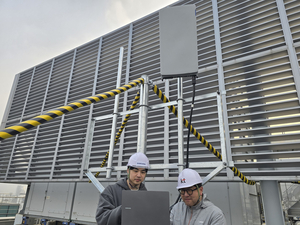 Samsung verifies 6G candidate-band antenna technology with KT, Keysight
koreaherald.com
Samsung verifies 6G candidate-band antenna technology with KT, Keysight
koreaherald.com
Samsung says it has “verified” antenna technology for 6G candidate bands in a joint test with South Korea’s KT and test-equipment vendor Keysight, according to The Korea Herald. The announcement is framed as progress toward sub-terahertz (sub-THz) mobile, where extremely wide channels can theoretically deliver eye-watering data rates—if you can keep a pencil-thin beam pointed at a moving handset without cooking the front-end.
What’s actually new here is less a single breakthrough than a packaging of known hard problems: high-gain beamforming, massive MIMO, and RF front-end integration at frequencies where path loss, blockage, and phase noise punish every shortcut. Samsung’s claim centers on “ultra-high-density” antenna arrays—more elements in a smaller footprint—intended to push effective isotropic radiated power (EIRP) and beam-steering precision without turning the radio into a space heater. Keysight’s involvement matters because sub-THz validation is as much about measurement credibility (calibration, channel emulation, over-the-air test setups) as it is about silicon.
But a lab or controlled-field verification is not a network. Sub-THz links are fragile: oxygen absorption, human-body shadowing, rain attenuation, and the simple fact that walls remain stubbornly solid all conspire to turn “peak” throughput into a line-of-sight party trick. The press-release cadence is nevertheless predictable: spectrum discussions and auction positioning often start years before the propagation models stop laughing.
There’s also an unglamorous attack surface story hiding behind the shiny phased array. As radios become more software-defined—more calibration loops, adaptive beam management, AI-assisted scheduling, and remote-configurable RF parameters—the “RF stack” turns into a sprawling software system with all the usual failure modes: memory-safety bugs, supply-chain dependencies, and remote management interfaces that operators will demand for cost reasons. A 6G base station is not just a tower with antennas; it’s a distributed compute platform with RF front-ends attached.
That complexity interacts badly with the geopolitical reality that 6G is already a standards and industrial-policy contest. If the industry repeats the 5G playbook—centralized vendor stacks, opaque firmware, and government pressure for “lawful access”—sub-THz won’t just be hard to deploy; it will be hard to trust.
Samsung’s test with KT and Keysight shows sub-THz beamforming and dense arrays inching from theory toward engineering. It is not evidence that 6G will be ubiquitous, cheap, or meaningfully more private than what came before. Whether it becomes those things will depend less on antenna demos than on who controls the software, the spectrum, and the monitoring.