
Trump gives Iran 10–15 days for nuclear deal
US masses two carriers and strike aircraft in Middle East, Deadline diplomacy expands executive war discretion while Congress watches clock
Images
 U.S. Navy ships sail in the Arabian Sea on Feb. 6. The military buildup in the Middle East suggests U.S. President Donald Trump is giving himself discretion to launch a sustained campaign against Iran lasting many days.
japantimes.co.jp
U.S. Navy ships sail in the Arabian Sea on Feb. 6. The military buildup in the Middle East suggests U.S. President Donald Trump is giving himself discretion to launch a sustained campaign against Iran lasting many days.
japantimes.co.jp
 A solar farm in Nakai, Kanagawa Prefecture, in March 2016. Japan gets about a tenth of its electricity from solar panels despite having nearly no domestic production of photovoltaics (PVs).
japantimes.co.jp
A solar farm in Nakai, Kanagawa Prefecture, in March 2016. Japan gets about a tenth of its electricity from solar panels despite having nearly no domestic production of photovoltaics (PVs).
japantimes.co.jp
 Sonic the Hedgehog, Castlevania's Alucard and the weak yet lovable Slime from Dragon Quest are just some of Japan's iconic gaming franchises celebrating midlife anniversaries in 2026.
japantimes.co.jp
Sonic the Hedgehog, Castlevania's Alucard and the weak yet lovable Slime from Dragon Quest are just some of Japan's iconic gaming franchises celebrating midlife anniversaries in 2026.
japantimes.co.jp
 A Ukrainian rises in the traditional world of sumo
japantimes.co.jp
A Ukrainian rises in the traditional world of sumo
japantimes.co.jp
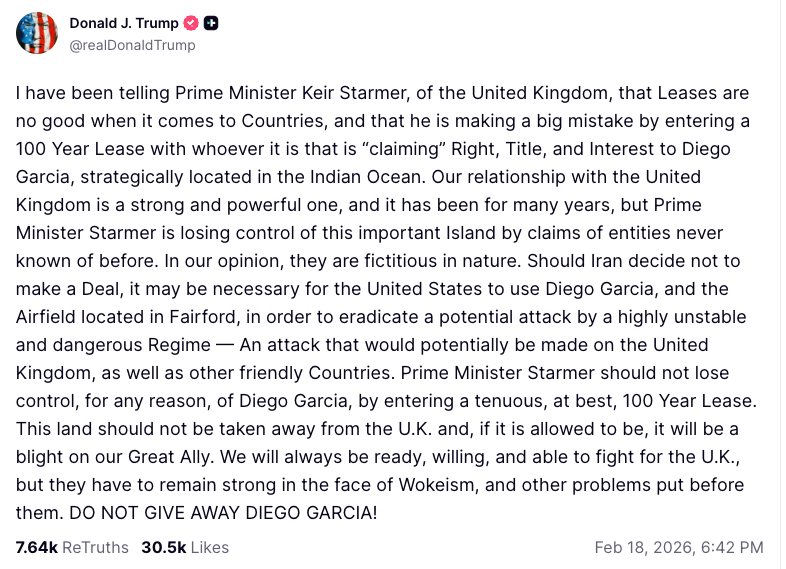 Truth Social (Truth Social)
Truth Social
Truth Social (Truth Social)
Truth Social
The Trump White House is once again staging a kind of “diplomacy”: an ultimatum backed by naval steel.
According to Bloomberg, as republished by the Japan Times, the US is massing major forces in the Middle East—two aircraft carriers, fighter jets, and aerial refueling tankers—while President Donald Trump says Iran has “10 to 15 days at most” to accept a nuclear deal. Speaking aboard Air Force One, Trump framed the choice with his usual subtlety: “We’re either going to get a deal, or it’s going to be unfortunate for them.”
France24 reports Tehran is responding in kind, warning that US bases in the region would be targeted if Washington strikes. That threat is not a mere rhetorical flourish; the proliferation of US bases and “temporary” deployments across the Gulf is exactly what makes escalation so easy for presidents and so hard for anyone else to unwind.
The key political fact is not the number of ships; it’s the discretion being accumulated. A “deal-or-war” deadline is a tool for executive power: it compresses decision-making into a narrow window, minimizes legislative scrutiny, and turns war planning into a negotiating tactic. Congress, which the Constitution assigns war powers, is reduced to watching a clock the president set himself—then being told that events “left no choice.”
The military buildup also signals something more durable than a “limited” strike. As Bloomberg notes, the posture gives Trump the option to launch a sustained campaign “lasting many days.” That’s the Iraq 2003 pattern in miniature: first the deadline, then the “limited” opening move, then the mission creep that arrives with its own bureaucratic constituency—bases, sanctions architecture, intelligence programs, and the inevitable insistence that withdrawal would be “irresponsible.”
An Atlantic Council analysis—hardly an anti-interventionist venue—urges Trump to answer six questions before striking Iran, including what the objective is, how escalation would be controlled, and what comes after the first wave. The fact that such basic questions must be asked in public tells you how little institutional friction remains inside Washington once the machinery is spun up.
Iran’s nuclear program is a serious issue. But the method being chosen—deadline diplomacy underwritten by carrier strike groups—has a predictable domestic payoff: it allows the executive branch to treat war as an extension of bargaining, while treating oversight as a nuisance. If a deal materializes, the White House claims victory; if it doesn’t, the same preparations become the justification for action.
The ultimatum is not just aimed at Tehran. It’s aimed at Congress, the public, and anyone who still believes that declarations of war are supposed to be more than a press line delivered at cruising altitude.