
Craig Tindale: Globalisation ends as physics returns
Central-bank liquidity rituals meet energy and supply-chain constraints, planners offer more planning as the cure
Images
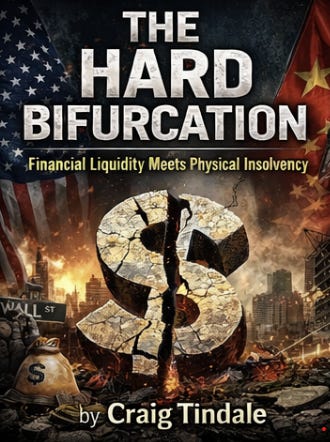 THE HARD BIFURCATION: The Convergence of Financial Liquidity and Physical Insolvency
substack.com
THE HARD BIFURCATION: The Convergence of Financial Liquidity and Physical Insolvency
substack.com
Craig Tindale argues that the era branded as “globalisation” was less a triumph of frictionless markets than a temporary credit-and-energy hallucination. In his Substack essay, he frames the last few decades as a period when cheap capital, cheap shipping, and geopolitical complacency made it appear that production could be scattered across the planet with little penalty. That illusion, he says, is now colliding with the stubborn reality of physics: energy density, materials throughput, and logistics constraints do not negotiate with central bankers.
The core claim is simple and unfashionable: money is not the economy. Liquidity can reprice assets and postpone bankruptcies, but it cannot conjure diesel, copper, fertiliser, container capacity, or skilled labour out of thin air. Yet Western policy has repeatedly treated finance as the master switch. When supply chains seize or energy prices spike, the reflex is still to reach for rate cuts, balance-sheet expansion, and subsidy schemes—rituals that look impressive on a Bloomberg terminal while leaving factories waiting on components.
Tindale’s broader point is that geopolitics has re-entered the picture not as a “risk factor” but as a primary constraint. The system that assumed trade routes would remain open, sanctions would be symbolic, and rivals would remain “responsible stakeholders” is giving way to a world where chokepoints, export controls, and industrial policy are explicit weapons. He notes that Western industrial capacity was not merely outcompeted; it was politically dismantled under the assumption that global supply would always be available at the right price, delivered on time, and insured by someone else’s navy.
The same institutions that helped create the fragility—central banks suppressing price signals, governments subsidising offshoring, regulators strangling domestic energy—now present themselves as the indispensable managers of the crisis. If you break the feedback mechanism, you don’t get stability; you get a bigger crash later.
The essay also reads as a warning against a fashionable policy pivot: “reindustrialisation” by decree. If the diagnosis is physical scarcity and logistical vulnerability, the cure is not another layer of top-down planning. Industrial resilience comes from decentralised decision-making, hard budget constraints, and prices that are allowed to communicate reality—especially in energy.
Tindale’s conclusion is bleak but clarifying: the West is discovering that spreadsheets cannot substitute for steel mills, and that monetary policy cannot print supply chains. Physics is back, and it is unimpressed by press conferences.