
Starliner review blames NASA and Boeing for cascading failures
Public-private risk sharing turns into paperwork engineering, taxpayers fund redundancy while bureaucracy manufactures fragility
Images
 NASA's new chief rebukes Boeing, space agency over problem-plagued Starliner mission that left astronauts stuck in space for months
cbsnews.com
NASA's new chief rebukes Boeing, space agency over problem-plagued Starliner mission that left astronauts stuck in space for months
cbsnews.com
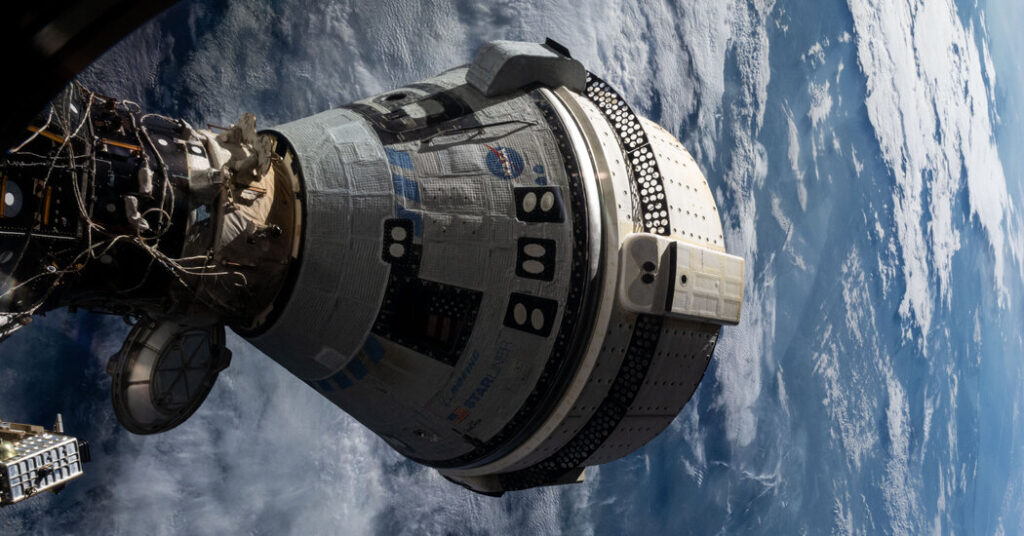 Investigators Blame NASA and Boeing for Starliner Failures
dnyuz.com
Investigators Blame NASA and Boeing for Starliner Failures
dnyuz.com
An independent review of Boeing’s Starliner program is now pointing fingers at both NASA and Boeing for a mission that was supposed to restore US redundancy in crewed spaceflight—and instead delivered an example of how to socialize risk while privatizing blame.
According to dnyuz.com’s summary of the investigators’ findings, the review concludes that NASA and Boeing share responsibility for Starliner’s failures. CBS News reports that NASA’s new chief has publicly rebuked both Boeing and the agency over the “problem-plagued” mission, underscoring that the dysfunction is not merely technical but institutional.
Starliner’s troubles have been a slow-motion collision between engineering reality and procurement incentives. NASA is nominally the risk owner: it sets human-rating requirements, approves hazard reports, and controls certification gates. Boeing is the prime contractor: it builds the vehicle, manages suppliers, and is supposed to deliver a working spacecraft. In practice, the system often produces the worst of both worlds—bureaucratic process overhead plus contractor execution that can be “managed” as a paperwork problem until physics intervenes.
The review’s core message is familiar to anyone who has watched cost-plus aerospace contracting metastasize. When the customer is a government agency that cannot tolerate visible failure, the contractor is incentivized to optimize for compliance artifacts: documentation, review boards, and schedule narratives that keep funding flowing. Technical debt can be deferred as long as milestones can be certified on paper. When the bill is ultimately paid by taxpayers, the penalty function for delay and rework is softened.
This is precisely why NASA has struggled to replicate SpaceX-style iteration and vertical integration. SpaceX can accept higher test cadence and more visible failure because it controls design decisions end-to-end and has a corporate culture that treats hardware as truth. NASA, by contrast, is structurally designed to prevent embarrassment—so it builds layers of oversight that are then outsourced into contractor slide decks.
CBS notes the new NASA chief’s unusually blunt criticism. That’s politically useful theater, but the reform instinct in Washington is predictable: more reporting requirements, more cross-agency task forces, more data-sharing and audit trails, and more “independent” reviews—i.e., more process.
If Starliner’s postmortem becomes another justification for tightening procurement rules and expanding compliance, the US will get what it always gets: fewer bidders, higher barriers to entry, and even more dependence on the same legacy primes whose business model is extracting value from the state’s inability to walk away.
Real accountability requires the freedom to fail—and the freedom to fire. Government programs rarely allow either. So they buy redundancy, then regulate it into fragility.