
UK plans easier deer culls in England
Predator-free trophic cascade drives woodland browsing and regeneration failure, state first removes wolves then subsidizes bullets
Images
 The red deer is one of two deer species present in England that are native. Photograph: Mike Unwin/The Guardian
theguardian.com
The red deer is one of two deer species present in England that are native. Photograph: Mike Unwin/The Guardian
theguardian.com
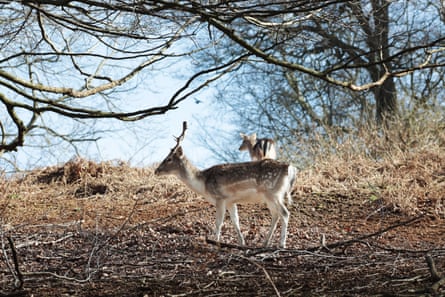 Overpopulation of deer affects woodlands as they eat leaves, buds and sapling stalks, and damage young trees with their antlers. Photograph: Martin Godwin/The Guardian
theguardian.com
Overpopulation of deer affects woodlands as they eat leaves, buds and sapling stalks, and damage young trees with their antlers. Photograph: Martin Godwin/The Guardian
theguardian.com
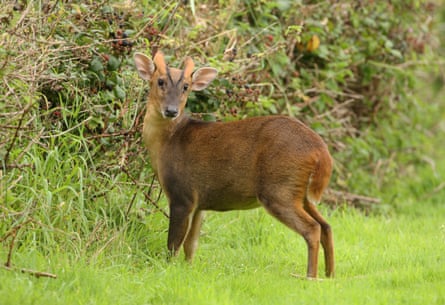 The muntjac deer is listed as an invasive species, and along with the similarly non-native sika and Chinese water deer, deemed to be causing the most damage to woodland. Photograph: FLPA/Rex/Shutterstock
theguardian.com
The muntjac deer is listed as an invasive species, and along with the similarly non-native sika and Chinese water deer, deemed to be causing the most damage to woodland. Photograph: FLPA/Rex/Shutterstock
theguardian.com
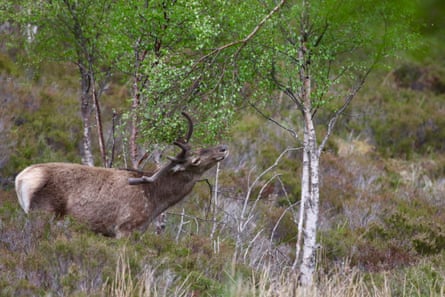 A red deer eats silver birch. ‘Our trees and native wildlife are under huge strain from deer damage,’ said Mary Creagh, the nature minister. Photograph: Mike Unwin/The Guardian
theguardian.com
A red deer eats silver birch. ‘Our trees and native wildlife are under huge strain from deer damage,’ said Mary Creagh, the nature minister. Photograph: Mike Unwin/The Guardian
theguardian.com
Britain’s deer problem is about to be solved the traditional way: by making it easier to shoot them.
The Guardian reports that the UK government plans legislation to give landowners and tenants clearer legal rights to cull deer to protect crops and property, alongside a more formalized deer-management regime on publicly owned land. Officials argue that growing deer populations are damaging woodlands, browsing saplings, stripping bark, and even killing young trees through antler-raking—especially by sika deer. Government figures cited by the Guardian say 33% of English woodlands are now in “unfavourable condition” due to deer impacts, up from 24% in the early 2000s.
The ecology is straightforward. Remove apex predators and you don’t remove predation; you outsource it to humans, fences, and bureaucracy. England has no wolves, bears, or lynx to impose continuous selection pressure on deer behavior and density. In that vacuum, deer populations can rise until food limitation, disease, or periodic culls do the regulating.
What’s less straightforward is measurement and causality. “Unfavourable condition” is an administrative category, not a mechanistic model. Deer browsing pressure interacts with woodland type, understory composition, regeneration rates, and local land use. The same density can be tolerable in one landscape and catastrophic in another, depending on whether browsing hits the regeneration bottleneck (seedlings and saplings) and whether there are refugia.
The Guardian notes the government has historically leaned on tree guards and fencing rather than population reduction. That approach is biologically coherent but economically and institutionally perverse: it treats symptoms by wrapping individual trees in plastic and steel while leaving the population driver untouched. It also shifts costs toward whoever is trying to regenerate woodland, and it can fragment habitat and impede movement of other species.
The new plan reportedly includes identifying “national priority areas” for targeted culls and adjusting grants so landowners can be paid to shoot deer outside woodlands, reflecting how deer move across patchy landscapes. Natural England officials also point to climate change: warmer winters improve overwinter survival and can increase reproductive success.
There is an angle here that policymakers will avoid stating plainly: property rights are a conservation tool. If landowners are held responsible for woodland condition but denied practical authority to manage herbivore pressure, they will rationally choose defensive infrastructure and paperwork over ecological outcomes. Conversely, if rights to manage are clarified—along with liability boundaries—then local experimentation becomes possible: different cull intensities, timing, and coordination across neighboring parcels.
The state, having long since eliminated predators and then subsidized fences to compensate, now proposes to fix its own trophic cascade with legislation and grants. Nature will accept the outcome either way; it’s the administrative layer that insists on narrating every bullet as a “strategy.”