
UK government plans easier deer culls in England
Woodland targets and invasive species drive new shooting rights and grants, Commons tragedy solved with more central planning
Images
 The red deer is one of two deer species present in England that are native. Photograph: Mike Unwin/The Guardian
theguardian.com
The red deer is one of two deer species present in England that are native. Photograph: Mike Unwin/The Guardian
theguardian.com
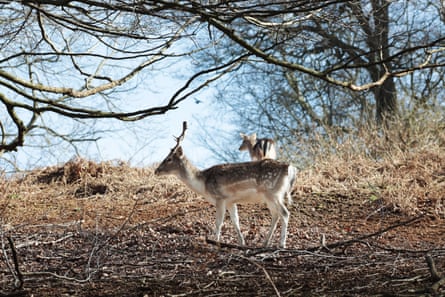 Overpopulation of deer affects woodlands as they eat leaves, buds and sapling stalks, and damage young trees with their antlers. Photograph: Martin Godwin/The Guardian
theguardian.com
Overpopulation of deer affects woodlands as they eat leaves, buds and sapling stalks, and damage young trees with their antlers. Photograph: Martin Godwin/The Guardian
theguardian.com
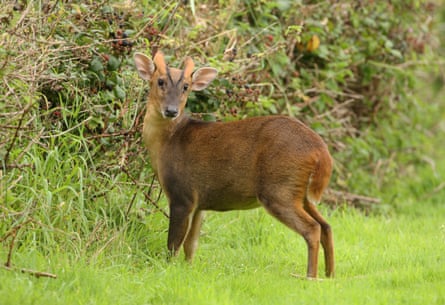 The muntjac deer is listed as an invasive species, and along with the similarly non-native sika and Chinese water deer, deemed to be causing the most damage to woodland. Photograph: FLPA/Rex/Shutterstock
theguardian.com
The muntjac deer is listed as an invasive species, and along with the similarly non-native sika and Chinese water deer, deemed to be causing the most damage to woodland. Photograph: FLPA/Rex/Shutterstock
theguardian.com
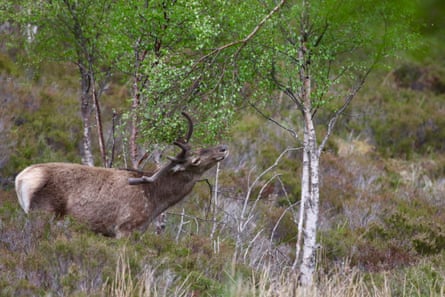 A red deer eats silver birch. ‘Our trees and native wildlife are under huge strain from deer damage,’ said Mary Creagh, the nature minister. Photograph: Mike Unwin/The Guardian
theguardian.com
A red deer eats silver birch. ‘Our trees and native wildlife are under huge strain from deer damage,’ said Mary Creagh, the nature minister. Photograph: Mike Unwin/The Guardian
theguardian.com
England’s deer problem is what you get when nobody owns the downside.
According to The Guardian, the UK government plans legislation to make it easier to shoot deer in England by giving landowners and tenants clearer legal rights to cull animals to protect crops and property. The policy is framed as a response to escalating damage to woodlands: deer browse saplings, strip bark from mature trees, and — in the case of sika — can kill young trees by raking antlers against them. Government figures cited by the paper say 33% of English woodlands are now in “unfavourable condition” due to deer impacts, up from 24% in the early 2000s.
The official story is ecological: legally binding targets require regenerating woodland equivalent to a net increase of 43,000 hectares, a goal that becomes awkward when the herbivores treat new plantings as an all-you-can-eat buffet. The Guardian notes that policy has leaned on guards and fences rather than population control. Now the state wants to pivot: publicly owned or managed land is to have deer-management plans within 10 years, “national priority areas” will be designated for targeted culls, and grants will be redesigned to pay for shooting deer even when they move outside woodland — an attempt to track a population that doesn’t respect administrative boundaries.
The angle isn’t “pro” or “anti” culling. It’s that the government has spent decades cultivating the institutional conditions for this exact kind of central plan. England has no natural apex predators — wolves, bears, lynx and others were exterminated long ago — and large parts of the landscape are governed through overlapping public mandates, fragmented rights, and liability rules that make local problem-solving expensive.
The Guardian quotes Natural England’s Emma Dear arguing that warmer winters and changing deer behaviour are increasing survival and reproduction. Climate breakdown, meet predator breakdown: two grand narratives that conveniently point back to the same solution — more state management.
There is a real property-rights problem here: deer are mobile capital with negative externalities. If the costs of deer are dispersed across neighbours, foresters, and farmers, while the benefits (sport, aesthetics, “wildlife”) are privately enjoyed or politically valorised, then under-culling is predictable. But “fixing” this by statute — mapping priority zones, writing ten-year plans for public land, and adjusting subsidies — is simply the state reasserting control over a problem it helped create.
A more adult approach would look like enforceable liability and contracting: clear responsibility for damage, tradable culling rights, local associations with real authority, and insurance mechanisms that price deer impacts. Instead, the government is doing what it does best: turning a coordination failure into a permanent regulatory program, complete with grant criteria and bureaucratic discretion.
The deer will keep moving. The paperwork will too — just with better funding.