
Trump launches Gaza Board of Peace with $10bn US pledge
Nations promise troops and relief funds, new committee markets itself as UN substitute while war logic persists
Images
 Key Takeaways From Trump's First Gaza Board of Peace Meeting
time.com
Key Takeaways From Trump's First Gaza Board of Peace Meeting
time.com
 Gaza ‘stabilization force’ commander outlines security plans
aljazeera.com
Gaza ‘stabilization force’ commander outlines security plans
aljazeera.com
 Qatar pledges $1bn for Gaza peace mission
aljazeera.com
Qatar pledges $1bn for Gaza peace mission
aljazeera.com
 Trump announces billions of dollars in Gaza aid at Board of Peace meeting
aljazeera.com
Trump announces billions of dollars in Gaza aid at Board of Peace meeting
aljazeera.com
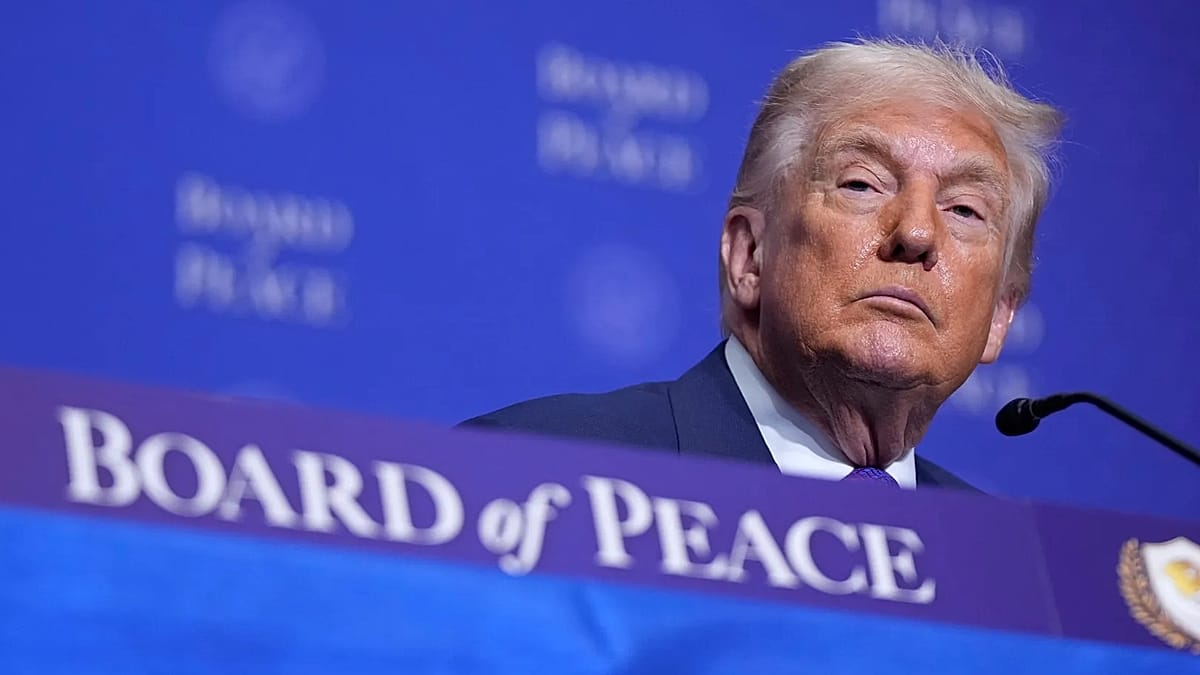 Trump launches his 'Board of Peace' as US-Iran tensions escalate
euronews.com
Trump launches his 'Board of Peace' as US-Iran tensions escalate
euronews.com
President Donald Trump has launched what he is openly marketing as an alternative power center to the United Nations: a “Board of Peace” that promises money, troops, and oversight — and, inevitably, a new layer of committees between violence and accountability.
At the Board’s first meeting, Trump announced a $10 billion U.S. commitment for Gaza, according to Al Jazeera. Time reports that nine nations pledged a combined $7 billion in relief, while five countries pledged “boots on the ground.” The same Time summary notes that Trump said the Board would be “looking over” the U.N. — a phrase that manages to sound both managerial and vaguely threatening.
The pitch is straightforward: reconstruction funding paired with a new security architecture. The incentives are equally obvious. For participating states, membership offers influence over postwar governance and contracts; for Washington, it offers a way to bypass the messy legitimacy of the U.N. while still claiming the moral halo of “international cooperation.”
If this sounds like privatized UN cosplay, that’s because it is structured like a product. Inputs: cash pledges, troop contributions, and political buy-in. Outputs: “stabilization,” allocation of aid flows, and a new venue for bargaining. The missing line item is the one that always matters: who gets to decide when “peace” requires force.
Euronews reports the Board’s launch comes as U.S.-Iran tensions escalate — a context that matters because “peace boards” tend to expand their remit whenever a new crisis appears. Time likewise lists Iran as a central tension point in the meeting’s takeaways. The Board is being introduced not in a moment of calm administrative reform, but in the middle of regional escalation — exactly when new institutions are most likely to be used as political cover for old-fashioned coercion.
Al Jazeera’s account frames the initiative as humanitarian aid. But the structure — money plus security plus oversight — is the classic architecture of externally managed territory. It is also a convenient way to launder responsibility: when outcomes are bad, blame can be distributed across a “multinational” body; when outcomes are good, leaders can claim credit.
The objection is not that private coordination is inherently illegitimate. It’s that this is not private. It is state power, state money, and state troops — reorganized under a new brand to reduce friction and increase discretion. The U.N. has long served as a fig leaf for interventions; Trump’s Board of Peace appears designed to be a thicker, more customizable fig leaf.
Whether it will function as a genuine governance alternative or as a cartel for reconstruction and security contracting will depend on its enforcement mechanisms: who commands the “boots on the ground,” what rules constrain them, and what happens when locals reject the plan. On those questions, the Board’s early messaging offers plenty of confidence — and very few details.