
India AI Impact Summit ejects Galgotias University after robot-dog demo
Chinese-made quadruped passed off as Indian innovation, AI-industrial policy turns into procurement theatre
Images
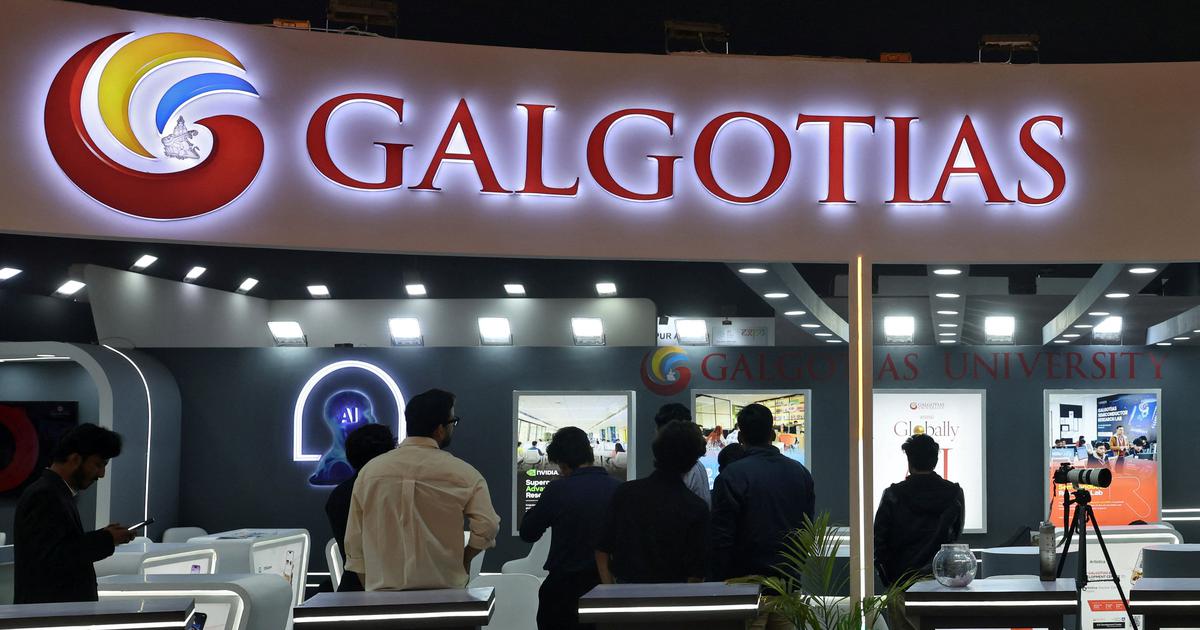 Visitors stand at the Galgotias University kiosk at Bharat Mandapam, one of the venues for AI Impact Summit, in New Delhi on February 18.
|
Bhawika Chhabra/Reuters
scroll.in
Visitors stand at the Galgotias University kiosk at Bharat Mandapam, one of the venues for AI Impact Summit, in New Delhi on February 18.
|
Bhawika Chhabra/Reuters
scroll.in
India’s attempt to brand itself as the Global South’s AI convenor ran into a familiar problem: reality.
According to Reuters, Indian authorities told Galgotias University to leave the India AI Impact Summit in New Delhi after the university showcased a robot dog that was allegedly manufactured in China while presenting it as an Indian product. The incident unfolded at Bharat Mandapam, one of the summit venues, and quickly became a social-media spectacle—precisely the kind of “AI optics” event planners promise will be avoided when they talk about “capability building.”
The episode is not merely a PR stumble. It is a neat microcosm of what happens when governments turn “AI leadership” into a KPI and institutions respond rationally to incentives. A summit booth is not a laboratory; it is a stage. When prestige, funding and political access are allocated to whoever can produce the most impressive demo by Tuesday, the market clears for Potemkin systems—imported hardware, rebranded software, and a thick layer of patriotic narration.
Scroll.in frames the Galgotias affair as “AI-washing,” borrowing the logic of greenwashing: organizations exaggerate technological sophistication to win customers, investors, or regulators. The piece draws a straight line from the 18th-century “Mechanical Turk” hoax to modern “AI” demos that conceal human labor or off-the-shelf components. It cites high-profile cases where ostensibly autonomous systems were later revealed to rely heavily on humans: Amazon’s cashierless stores, for example, were reported to be monitored by workers who “validate” shopping sessions; and Tesla’s Optimus robots have faced scrutiny over how much is teleoperation versus autonomy.
Those examples matter because India’s AI push is increasingly entangled with state procurement and institutional signaling. When ministries, universities and local governments are rewarded for announcing “AI-powered” initiatives—smart cities, AI universities, AI governance frameworks—verification becomes optional. The downside risk is socialized: taxpayers fund the programs, citizens become the test environment, and accountability diffuses across committees.
The Galgotias booth fiasco also highlights a more awkward truth for a country seeking technological sovereignty: supply chains are global, and China dominates many categories of robotics manufacturing. If the political requirement is “domestic,” the temptation is not to build better—building is slow—but to relabel.
The lesson is banal but consistent: when the state manufactures prestige and money around buzzwords, it reliably produces fraud-adjacent behavior. The correction mechanism is not another committee or summit code of conduct. It is competition, disclosure, and the freedom for embarrassing failures to happen without turning them into criminal or political crises—because iterative progress requires the right to fail publicly. India’s summit tried to project competence. It instead demonstrated the incentive structure.