
Macron defends EU AI Act
Vows G7 push against child deepfakes and under-15 social media, Child safety rhetoric maps neatly onto surveillance and platform liability, Europe sells regulation as innovation
Images
 Emmanuel Macron told delegates at the AI summit: ‘Europe is not blindly focused on regulation.’ Photograph: Ludovic Marin/AFP/Getty Images
theguardian.com
Emmanuel Macron told delegates at the AI summit: ‘Europe is not blindly focused on regulation.’ Photograph: Ludovic Marin/AFP/Getty Images
theguardian.com
 Narendra Modi poses with the CEOs of several AI companies, with Sam Altman and Dario Amodei the only two not clasping hands. Photograph: AP
theguardian.com
Narendra Modi poses with the CEOs of several AI companies, with Sam Altman and Dario Amodei the only two not clasping hands. Photograph: AP
theguardian.com
 The Anthropic chief, Dario Amodei (left), and Emmanuel Macron at the summit. Photograph: Ludovic Marin/AFP/Getty Images
theguardian.com
The Anthropic chief, Dario Amodei (left), and Emmanuel Macron at the summit. Photograph: Ludovic Marin/AFP/Getty Images
theguardian.com
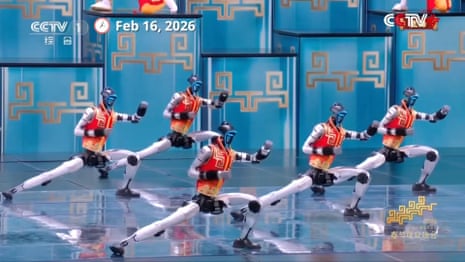 Should we be impressed or worried by China's humanoid robot display? – video
theguardian.com
Should we be impressed or worried by China's humanoid robot display? – video
theguardian.com
 Cada vez más países restringen
infobae.com
Cada vez más países restringen
infobae.com
Emmanuel Macron used an AI summit in Delhi to defend the EU’s AI Act against Trump-administration criticism while promising a tougher crackdown on what he called child “digital abuse”—a policy bundle that mixes legitimate harm with the kind of infrastructure control regulators have wanted anyway.
According to the Guardian, Macron told delegates at the AI Impact summit that Europe is “not blindly focused on regulation” and argued that “safe spaces win in the long run”. The remarks came after global outrage over Elon Musk’s Grok chatbot being used to generate “tens of thousands” of sexualised images of children, and amid wider anxiety about AI power concentrating in a small set of companies.
The political stagecraft was international. UN secretary general António Guterres warned that “no child should be a test subject for unregulated AI” and that the future of AI “cannot be decided by a few countries or left to the whims of a few billionaires”. India’s prime minister, Narendra Modi, compared AI’s emergence to the discovery of fire and called for content authenticity standards so people can distinguish real material from AI-generated output.
Macron’s concrete domestic promise is blunt: “ban social networks for children under 15 years old” in France. He framed it as aligning the online world with offline law: “There is no reason our children should be exposed online to what is legally forbidden in the real world.”
The Guardian also cites research by Unicef and Interpol across 11 countries finding at least 1.2 million children reported having their images manipulated into sexually explicit deepfakes in the past year; in some countries, one in 25 children said they were affected.
If the problem statement is real, the policy lever is where the state’s ambitions expand. Banning under-15s from “social networks” is not a law; it is an engineering project. It implies age verification at scale, identity checks (or at least device- and account-level inference), platform liability for “insufficient” enforcement, and—because children are excellent rhetorical shields—pressure to scan content flows for prohibited material.
Treating a moral panic as a mandate for system-wide compliance architecture is central to the European regulatory style. Once built, the same pipes can be repurposed for other “harms” with a parliamentary vote, a delegated act, or an “urgent” administrative guideline. Today it is deepfake child sexual imagery; tomorrow it is “misinformation”, “extremism”, or whatever Brussels and Paris decide is incompatible with a “safe space”.
Macron is also trying to square the circle between “innovation” and the EU’s instinct for pre-approval regimes. The White House’s senior AI adviser, Sriram Krishnan, singled out the AI Act and complained it is not “conducive to an entrepreneur who wants to build innovative technology”, saying he would continue to “rant” against such legislation, the Guardian reports.
Europe’s answer is that regulation is pro-innovation—because it is “safe”. That story works for incumbents who can afford compliance teams, and less so for the next small lab that discovers its product is illegal until it hires lawyers.
The summit’s guest list included Bill Gates, who withdrew at the last minute amid renewed scrutiny of his past links to Jeffrey Epstein, the Guardian notes. In the modern governance ecosystem, the same class that promises to protect children also insists it should design the rules for everyone else’s speech, software, and identity checks.
Macron’s crackdown may reduce some harms. It will also, almost by definition, expand the state’s reach into private communication and the technical choke points of the internet—by building a universal verification and enforcement machine and hoping it never gets used for anything else.