
North Aral Sea refills after Kokaral dam
Kazakhstan touts 36% surface gain while South Aral remains desert
Images
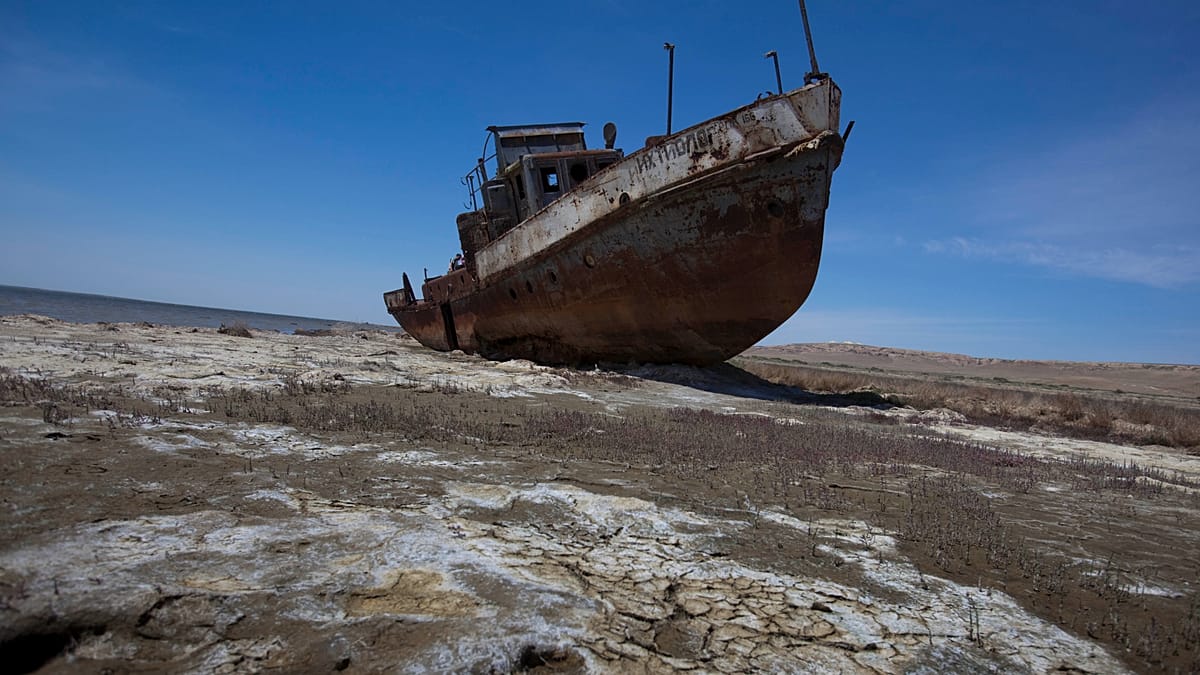 North Aral Sea restoration efforts show promise as water level rises
euronews.com
North Aral Sea restoration efforts show promise as water level rises
euronews.com
The Aral Sea—the Soviet Union’s most durable environmental monument—has produced an awkward headline for modern bureaucrats: part of it is coming back.
Euronews reports that Kazakhstan’s North Aral Sea has “regained a third of its water,” crediting a mix of hydraulic engineering and regional water management. President Kassym-Jomart Tokayev has been touring the achievement rhetorically, citing figures that the northern basin’s surface area has grown by 36% over roughly two decades, water volume has “nearly doubled,” and salinity has been cut in half.
The underlying story is less mystical than political: the Aral did not “dry up” because nature changed its mind, but because Moscow redirected its two feeder rivers—the Amu Darya and Syr Darya—into cotton irrigation beginning in the 1960s. By the mid-2010s, about 90% of the Aral Sea’s water mass was gone, the lake split into multiple hypersaline remnants, and the southern portion (mostly in Uzbekistan) largely collapsed into the Aralkum desert.
Kazakhstan’s relative success has a specific physical lever: the Kokaral dam, built in 2005, which effectively separated the North Aral from the doomed southern basins and allowed the Syr Darya’s inflow to raise water levels in the northern bowl rather than draining south into evaporation and salt flats. Euronews says a regional agreement among water ministers of Kazakhstan, Uzbekistan, Tajikistan and Kyrgyzstan also contributed by allocating inflows—an arrangement that, in Central Asia, is always one drought away from becoming a diplomatic grievance.
The numbers matter, and they are measurable. Kazakhstan’s Ministry of Water Resources and Irrigation—created in 2023, because every hydrological problem improves when you add a ministry—claims the Northern Aral’s volume has increased to 24.1 billion cubic metres since 2023, with roughly 5 billion cubic metres directed into the sea over that period. Euronews notes World Bank data indicating the water level is now about 50% higher than at its lowest point.
Unlike most “restoration” narratives, this one is unusually auditable from the outside. Surface area and water level can be checked with satellite imagery and altimetry; salinity trends can be sampled and published; fisheries can be counted. That makes it a rare environmental claim that doesn’t require the reader to simply trust a ministry press release, an NGO fundraising email, or both.
The Aral Sea disaster was born from central planning’s confidence that it could re-plumb a continent for agricultural quotas. The partial recovery of the North Aral now depends on another grand intervention—just with better feedback loops and a narrower target.
Kazakhstan is reportedly considering raising the Kokaral dam by two metres and building additional hydraulic infrastructure to stabilize nearby lake systems. If that happens, the next chapter won’t be written by slogans about “saving nature,” but by flow rates, reservoir operating rules, and whether upstream irrigation politics can be constrained by something more binding than speeches at a “National Kurultai.”